Family Command Center Ideas: Paper, Digital, or Both (2026)
TL;DR: A family command center is one decision — not furniture. It’s the choice that all your family’s information lives in ONE place, visible to everyone. Physical wall, digital app, or both — the format matters less than the commitment. Below: what to put in it, where, and how to stop being the only person who knows where anything is.
Tuesday, 7:50 AM. The school bus comes at 8:05. Your daughter can’t find the permission slip you signed last night. It’s somewhere — kitchen counter? Your bag? Under the homework folder that’s also missing? Your son is eating cereal with no shoes on. The dog needs out. Your partner is already in the car, texting “Where’s the lunch box?”
You stand in the hallway, one hand on a backpack that’s unzipped, the other holding your phone with three unread messages from school. The cold metal of the zipper presses into your thumb. The phone vibrates again.
Everything you need is somewhere in this house. And that’s the problem — it’s somewhere, not in one place.
Research shows that how people describe their home environment correlates with their daily cortisol patterns — in a UCLA study of 30 dual-income couples, wives who described their homes with more clutter-related language had flatter daily cortisol slopes (a marker of chronic stress) throughout the day.1 I don’t think the scattered-information problem is just annoying. It’s physiological.
The real problem isn’t organization — it’s information scatter
Forget the Pinterest boards for a moment. I don’t see a family command center as a home decor project. It’s an answer to a very specific question: “Where does this go so EVERYONE knows where to find it?”
Right now, your household information lives in at least six places: your head, your partner’s head, the fridge, a drawer, someone’s phone, and a stack of papers on the counter. You’ve become the human search engine — the only person who can cross-reference all of them.
A command center replaces you as the family’s memory. It becomes the one spot the whole household looks at — so nobody has to ask you.
What goes in it
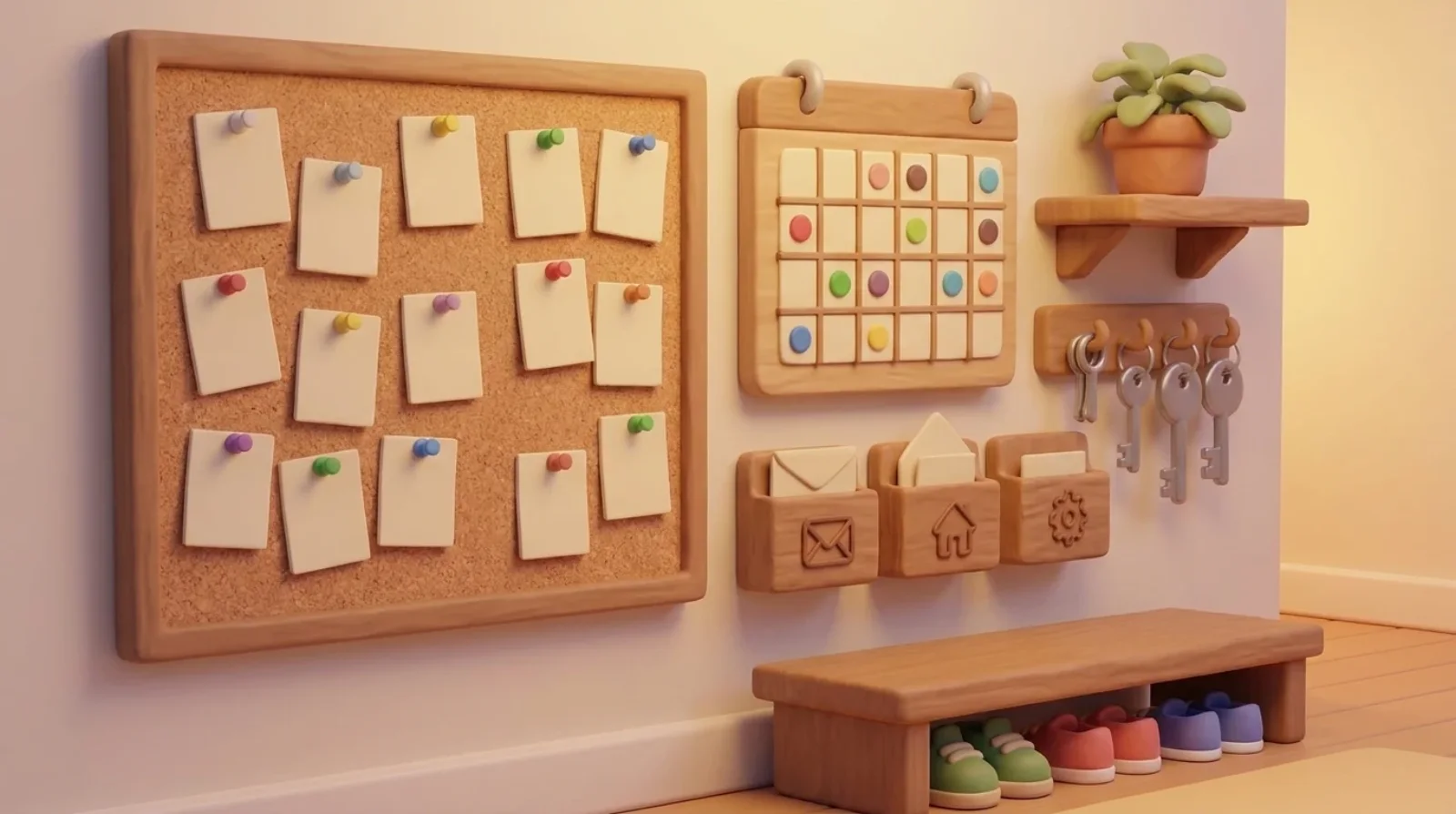
In my view, the best command centers cover a few core jobs, not every possible category:
- A shared calendar — the heart of it; everyone’s events in one view.
- A reminders board — cork or dry-erase for the week’s notes.
- An inbox for paper — trays or a folder for mail, school forms, and to-file items.
- Hooks and baskets — for backpacks, jackets, keys, and lunchboxes near the door.
- A meal plan spot — the week’s dinners where everyone can see them.
- A “launch pad” — a small zone where tomorrow’s essentials wait by the exit.
Evening. You come home, put your keys on the hook by the door. The satisfying click of metal on wood. On the shelf next to the hooks: three labeled bins — one per kid. Tomorrow’s permission slip goes into the first bin. You don’t think about it. You just do it. And tomorrow morning, your daughter won’t be searching.
Pause
If you’re reading this during one of those mornings — the permission slip kind — bookmark this page. Come back when the house is quiet. Nothing here needs to happen today.
Family command center ideas by space
Small space / renters
A single framed dry-erase calendar plus three wall hooks and one mail tray covers 80% of the value. No drilling required — use adhesive hooks and a magnetic board on the fridge.
Kitchen command center
Use the side of a cabinet or a wall near the kitchen for a calendar, a meal-plan board, and a small shelf for the family binder. I’d pick the kitchen, because everyone passes through it daily.
Entryway / mudroom
Best for the “in and out” gear: a hook per family member, a basket per person for shoes and sports kit, and a launch pad for tomorrow’s bags. Pair with a calendar so leaving the house gets calmer.
Whole-family hub
Combine a large monthly calendar, individual color-coded sections per person, a chore chart, a meal plan, and a paperwork station. Color-coding by family member makes a busy schedule readable at a glance.
Paper, digital, or both?
You’re at work. Your partner texts: “Where’s Emma’s dentist appointment card?” You have no idea — because it’s on the fridge, behind the drawing from last Tuesday. Or maybe in the kitchen drawer. You’re trying to remember, and you can feel your shoulders tightening because you SHOULD know this, and you don’t, and the appointment is in two hours.
That’s the moment a paper-only system breaks. The information is pinned to one wall in one house, and life doesn’t happen in one place.
| Paper command center | Digital command center | |
|---|---|---|
| Best for | Visibility at home, young kids, glanceable info | Busy families, two working parents, info on the go |
| Strengths | Always “on,” no devices, great for routines | Syncs everywhere, reminders, accessible when out |
| Limits | Stuck in one place; updates by hand | Needs a device; everyone has to use the same tool |
| Privacy | Total — your data stays home | Depends on the app — look for no-ads, no-tracking tools |
Many families land on both: a simple paper wall for daily glance-ability at home, backed by a digital hub so the schedule travels with them. The key, as I see it, is that everything points to a single source of truth — not two competing calendars.
When the wall isn’t enough: a command center that travels
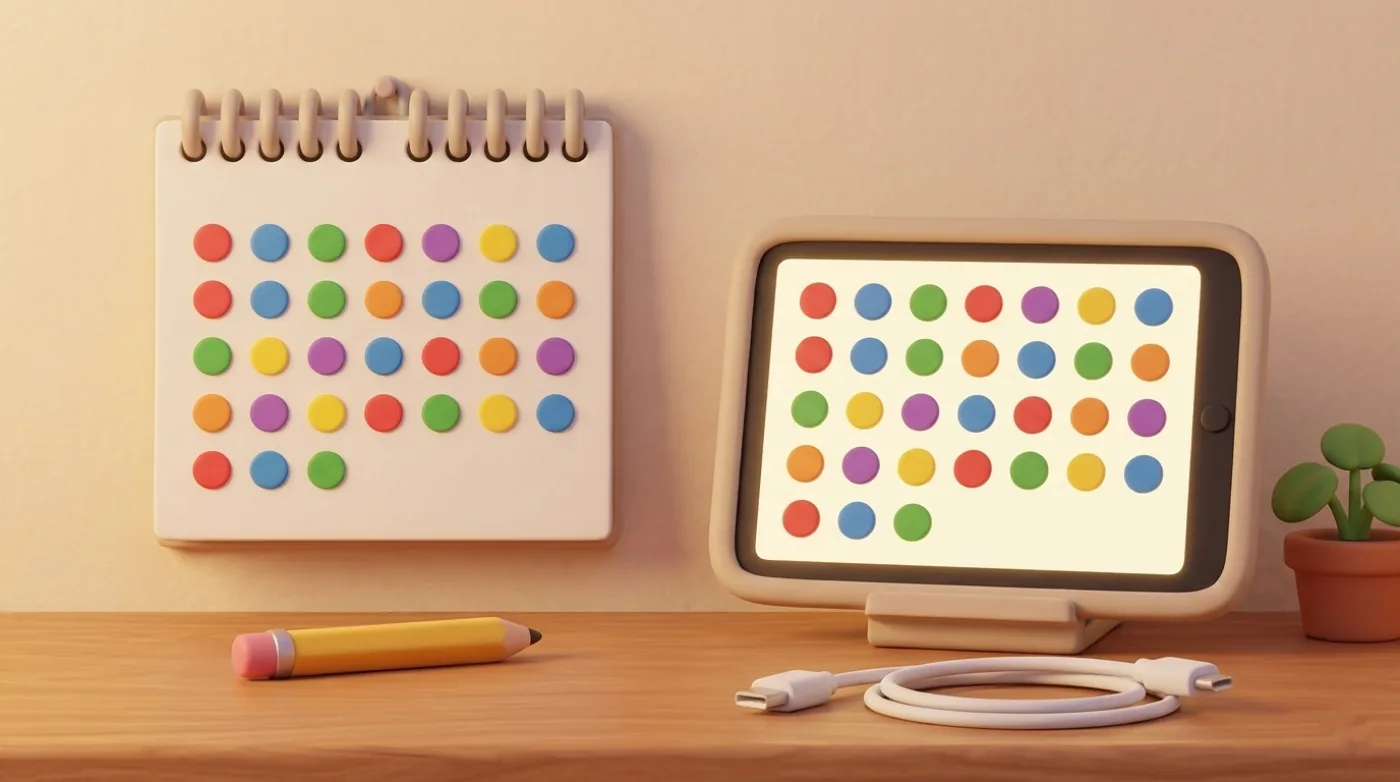
A wall calendar works until someone isn’t home to look at it. A whiteboard works until it’s full and nobody erases it. A paper command center works until the information needs to leave the house — and then you become the human sync between the fridge and everyone’s phones.
Before ParentOS I ran my own family on Google Calendar, three WhatsApp groups and hope. ParentOS is the family organization app I’m building to reduce the mental load of parenting — essentially a digital family command center: a shared calendar, routines, chores, meal plans, and lists in one place that every family member can see, at home or on the go. Keep your kitchen wall if you love it; let ParentOS be the source of truth behind it.
ParentOS — one look at the day, no surprises. A shared rhythm instead of constant reminding. Join the families testing it first — sign up for early access.
Command center starter kit
My advice: start small. Add layers only when the first one becomes a habit.
Essential (start here):
- One calendar (paper OR digital — pick ONE)
- Key hooks (one per adult)
- Backpack hooks (one per kid)
- “Needs signature” tray
Level 2 (add when ready):
- Meal plan for the week
- Chore chart
- Important contacts card
Level 3 (only if it helps):
- Budget / expense tracker
- Family goals board
Tonight: clear ONE spot near your front door. Put a basket for keys, a hook for backpacks, and tomorrow’s permission slip on top. That’s your command center. Everything else is decoration.
The original angle most people miss
Sunday evening. You walk past the command center on the way to the kitchen. You glance at the week — soccer Tuesday, dentist Thursday, pizza Friday. You don’t think about it. You just KNOW. And so does everyone else in the house. Nobody asks. Nobody reminds. The information is just… there.
A command center isn’t furniture — it’s a decision. The decision that information lives in one place, visible to everyone. It’s shared awareness made physical (or digital). The format doesn’t matter. The commitment does.
Most articles will show you beautiful mudroom setups with chalkboard paint and matching baskets. And I think those are fine. But the command center that actually works is the one where everyone in the family knows: if it matters, it goes HERE. Not on the counter. Not in a text. Not in someone’s head. Here.
That’s the whole idea.
Frequently asked questions
What should a family command center include? At minimum: a shared calendar, a reminders board, an inbox for paper, and hooks or baskets for daily gear. Many also add a meal-plan spot and a chore chart.
Where is the best place for a command center? A high-traffic area the whole family passes through daily — most often the kitchen or the entryway/mudroom.
Is a digital or paper command center better? Paper wins for at-home, glanceable visibility; digital wins for busy families who need the schedule on the go. Many use both, as long as one is the single source of truth.
How do I keep a command center from becoming cluttered? Give every item a home (trays, baskets, hooks), clear the paper inbox weekly, and keep only what the family actually uses.
Sources
Related articles
Calm families start with shared awareness.
Footnotes
-
Saxbe D.E., Repetti R.L. (2010). No Place Like Home: Home Tours Correlate With Daily Patterns of Mood and Cortisol. Personality and Social Psychology Bulletin, 36(1), 71–81. doi:10.1177/0146167209352864. PubMed. Sample: 30 dual-income couples (60 spouses); home tour language was analyzed with LIWC software; the cortisol slope effect was significant for wives but not husbands; study is correlational. ↩