Chore Chart by Age: What Kids Can Do at Every Stage (+ How to Make It Work)
TL;DR: Children can start helping around the house as early as ages 2–3, with chores matched to their abilities. A 2-year-old can put away toys, a 5-year-old can set the table, an 8-year-old can empty the dishwasher, and a teen can shop for groceries or cook a simple meal. Below is a full chore chart by age, plus a pediatrician-backed way to make chores actually stick — without daily battles.
6:45 PM. Kitchen.
Dinner’s done. Plates on the table, pasta cooling. Your child looks at you: “Can I go play?” Your partner walks out of the bathroom, hands still wet, towel over the shoulder.
You look at the pots on the stove. The crumbs under the chair. The sponge that no one wrung out.
You clean up because it’s faster. Because the child “does it wrong anyway.” Because you don’t have the energy for another round of please-just-bring-your-plate.
And every evening you do everything for everyone — the role confirms itself. This is YOUR job. Not because anyone decided that. Because no one decided otherwise.
Why this matters more than you think
A University of Minnesota longitudinal study by Marty Rossmann followed 84 children across four stages — preschool, around ages 10 and 15, and in their mid-20s. The strongest single predictor of success in young adulthood (relationships, career, self-sufficiency) was participating in household tasks beginning at ages 3–4 — ahead of socioeconomic background and educational opportunity.1
Children who started chores as teenagers showed weaker effects than those who started as toddlers.
That’s the data. But here’s the part I think the study doesn’t capture: chores aren’t a task for a child. They’re proof that the child belongs. That they’re part of something. That the kitchen after dinner is everyone’s problem, not just the person who happens to be standing closest to the sink.
Adults on the chore board too. That’s the point. When dad’s name is next to “wipe the counter” and mom’s is next to “take out trash” — the child sees a system, not a punishment.
Chore chart by age
A 3-year-old picks up a pair of balled-up socks from the floor and carries them across the hallway to the hamper. The lid flips open. The socks go in. A faint smell of laundry detergent drifts up. The lid claps shut. She looks at you, waiting. You nod. That’s it — that’s the whole thing.
I’d use this table as a starting point. Every child develops at their own pace, so treat age as a guide and match chores to your child’s real abilities.
| Age | Age-appropriate chores |
|---|---|
| 2–3 years | Put away toys, put clothes in the hamper, wipe up spills, put books away |
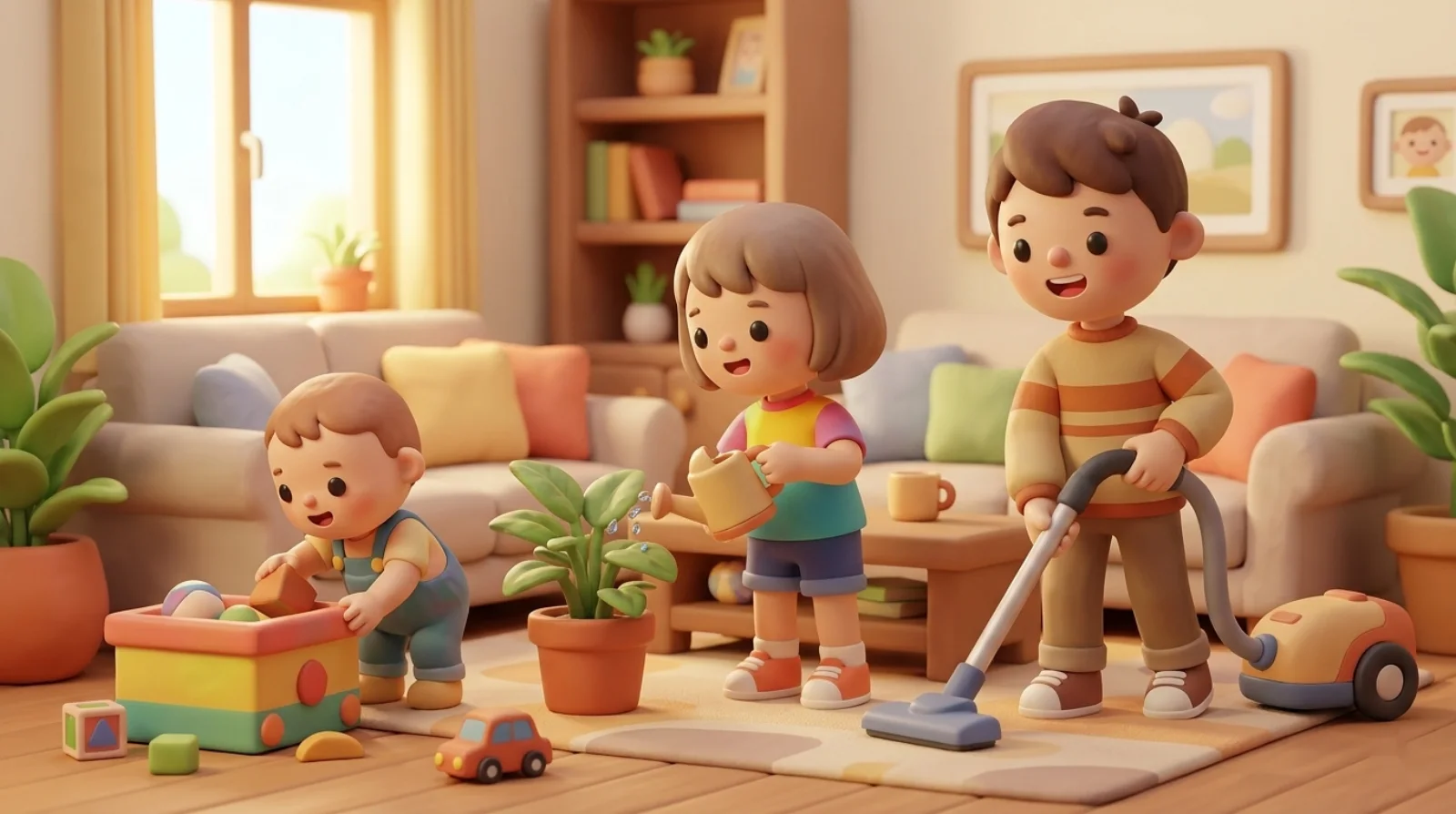
| 4–5 years | Set the table, make their bed, water plants, feed a pet, sort laundry |
| 6–7 years | Empty the dishwasher, dust, take out trash, pack their schoolbag, tidy their room |
| 8–9 years | Vacuum, make a simple sandwich, care for a pet, fold and put away laundry |
| 10–12 years | Wash dishes, cook simple meals with supervision, clean the bathroom, mow the lawn |
| 13+ years | Grocery shopping, cook a meal, do laundry, babysit younger siblings, minor repairs |
Tip: Don’t hand your child the whole list at once. Pick 2–3 regular chores and add more as each becomes a habit.
How to make chores stick — a pediatrician-backed approach
A list alone won’t help if every task ends in negotiation. Here’s how I’d make chores routine, drawing on guidance from the American Academy of Pediatrics on positive reinforcement.2
1. Start with one or two chores
Don’t overhaul the whole day at once. Pick one simple chore, let it become automatic, then add the next.
2. Show, don’t just tell
You stand at the dryer, pull out a bath towel — warm, slightly wrinkled, smelling of clean cotton. You fold it in half. Then in half again. Your child grabs one, folds it into something that’s more triangle than rectangle. Crooked. Lumpy. His.
“Here’s how we fold a towel” works better than “go fold the towels.” Kids learn by watching and doing, not by being told.
3. Attach chores to a fixed point in the day
Habits form fastest when a task has its moment: toys before dinner, schoolbag right after the afternoon snack. A steady rhythm takes you out of the role of the person who always has to remind everyone.
4. Make chores visible — and consider a reward chart
A chore chart on the fridge or in an app means everyone can see what’s theirs, without your constant supervision. If you use a reward chart, the AAP suggests a few specific principles: target just one or two behaviors at a time, let your child help choose meaningful rewards, avoid penalties or taking points away, and gradually phase the chart out as the habit takes hold.2
5. Praise effort, don’t only pay
Praise (“I love that you remembered on your own!”) builds internal motivation more effectively than paying for every task. A points or stars system works well as a supplement — as long as it doesn’t replace the feeling of being a helpful member of the family.
What to do when your child resists
It’s normal for kids to push back. Instead of a battle, I’d try:
- Offer a choice: “Do you want to set the table or water the plants?” — choice reduces resistance.
- Pair the chore with something fun: favorite music while tidying.
- Hold the boundary calmly: “Toys first, then a story” beats a raised voice.
- Praise effort, not perfection: crookedly folded laundry is still a win for a preschooler.
Pause
You don’t need to have this figured out by morning. Every change starts with one calm evening.
At dinner tonight, try one thing: ask your child “Can you carry your plate to the sink?” No reward. No speech. Just that.
Your family chore board
Below is a simple framework for a family chore board. My one rule: every family member — including adults — has at least one item.
| Who | Morning | After school / work | Evening |
|---|---|---|---|
| Mom | ____________ | ____________ | ____________ |
| Dad | ____________ | ____________ | ____________ |
| Child 1 | ____________ | ____________ | ____________ |
| Child 2 | ____________ | ____________ | ____________ |
Fill it in together. Stick it on the fridge. Cross things off. The point isn’t perfection — it’s visibility. When everyone sees the same board, no one person carries the full picture in their head.
The system remembers so you don’t have to
Saturday morning. Your older child walks into the kitchen before you do. You hear the quiet clink of plates being set on the table, one by one. Then the careful thud of a milk carton placed next to the glasses. No one asked. No one reminded. The chore board on the fridge did its job while you were still in bed.
For me, it’s not about the child doing more. It’s about you not having to remember that the child needs to do it. When chores are visible — on a chart, in one place — the system reminds, not mom. Not dad. The board.
ParentOS is the family organization app I’m building to reduce the mental load of parenting. Everyone sees what’s theirs, kids check off tasks, and you stop being the family’s reminder service. Shared awareness instead of constant reminding. If that resonates — join the early access.
Frequently asked questions
At what age can a child start doing chores? Around ages 2–3. Toddlers can happily put away toys or put clothes in the hamper — simple chores matched to their abilities.
Should kids be paid for chores? It’s a family decision. Many experts suggest treating basic chores as a family contribution and tying allowance to extra tasks, so payment isn’t the only motivation. (See the guide on allowance by age.)
How many chores should a child have? Start with 2–3 regular chores and add more as each becomes a habit. Consistency matters more than a long list.
What’s the best way to motivate kids to do chores? A fixed time of day, a visible chore chart, offering choices, and genuine praise for independence work best. A points or stars system can help as a supplement.2
Sources
Related articles
Calm families start with shared awareness.
Footnotes
-
Rossmann M.K. (2002). Involving children and adolescents in household tasks: Effects on children’s adult outcomes. University of Minnesota. Summary via Self Sufficient Kids: selfsufficientkids.com. Note: widely cited in parenting literature; the “Harvard Grant Study” chore connection popularized by Lythcott-Haims (2015) is an interpretation of the Grant Study, not a finding of that study itself — Rossmann’s longitudinal data is the more direct source. ↩
-
American Academy of Pediatrics (HealthyChildren.org) — Positive Reinforcement Through Rewards (adapted from Caring for Your School-Age Child: Ages 5 to 12, AAP). healthychildren.org ↩ ↩2 ↩3