
Summer Schedule for Kids: Anchors, Not Timetables
TL;DR: You don’t need a summer schedule. You need summer anchors — 3-4 fixed points (breakfast, screens-off, bedtime) that give the day shape without killing the freedom. Everything between anchors is free. The rhythm travels to grandma’s house, to camp, to vacation — because it’s simple enough to carry.
Day 4 of summer break. It’s 10:30 AM. Nobody is dressed. The house smells like leftover pancakes from yesterday — that sweet, slightly stale smell that means nobody cleaned the griddle. Your 7-year-old is watching his third YouTube video in a row. You can hear the autoplay jingle cycling from the living room. Your 4-year-old is following you from room to room saying “I’m boooored” in a voice that’s getting louder each lap.
You had plans for this summer. The art supplies, the reading list, the “screen-free mornings.” It’s Day 4. The art supplies are still in the Amazon box on the kitchen counter, the tape strip still intact.
And here’s the thing you’re starting to feel in your body — that low-grade hum of guilt mixed with overwhelm: summer without any structure isn’t freedom. It’s chaos wearing pajamas.
You don’t need a summer schedule. You need anchors.
I’ll skip the lecture about “the importance of summer routine.” You’ve read that article. It didn’t help.
Here’s what I think actually works: 3-4 fixed points that give the day shape without killing the freedom. Not a timetable. Not hour-by-hour blocks. Anchors.
An anchor is something that happens at roughly the same time every day, no matter what. Breakfast by 8:30. Screens after lunch. Bath starts at 7. That’s it. Everything between the anchors is free — outdoor play, crafts, reading, running through the sprinkler, doing absolutely nothing. The freedom isn’t gone. It’s framed.
A 2024 systematic review of 170 studies found that daily routines are broadly associated with positive developmental outcomes in children — better self-regulation, social-emotional skills, and mental health.1 But the key word is routines, not schedules. Predictable rhythms, not rigid timetables. Kids don’t need to know it’s 9:15 AM craft time. They need to know that after breakfast, they play — and screens don’t happen until after lunch.
What anchors actually feel like
9 AM. Sunlight through the kitchen window. The crunch of cereal. A rule that’s simple: screens after lunch. Nobody argues, because it’s Day 12 and the rule hasn’t changed once. Your 7-year-old doesn’t ask if he can watch something — he knows the answer. He grabs a book instead, or goes outside, or dumps the LEGO box on the floor. The absence of negotiation is the freedom.
That’s what I like about anchors: they remove the decision, which removes the argument, which removes the energy drain. You’re not enforcing a schedule. You’re maintaining a shape.
Before summer starts: decide three things
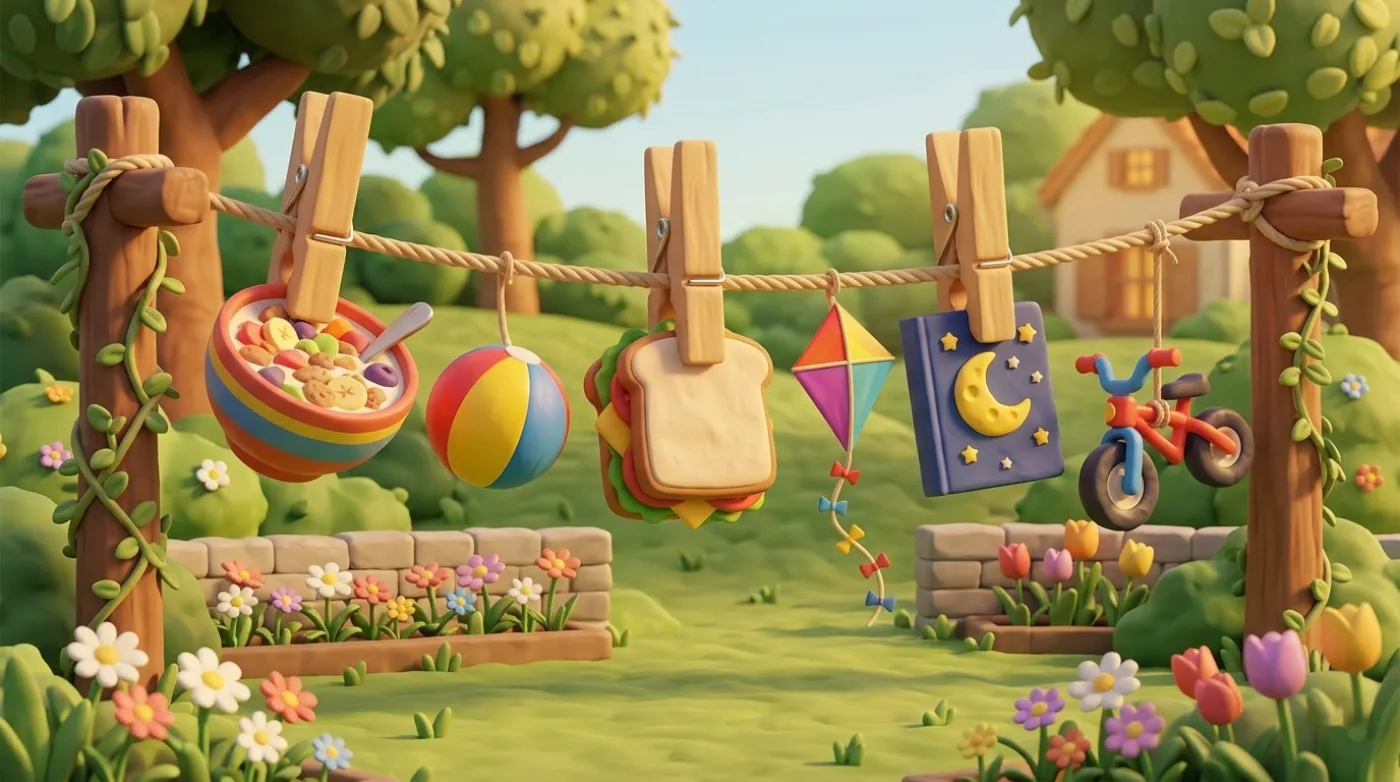
This is my whole method. Write these on the fridge:
- When breakfast is — this sets the day’s start. Not an alarm clock. Just: breakfast is ready at 8:30, and if you want it warm, you show up.
- When screens end (or start) — one clear boundary. “Screens after lunch, off by 3” is a complete screen-time policy for summer. No timer apps, no daily negotiation.
- When bedtime starts — not when lights go out. When the sequence begins: bath, teeth, story, lights. Keep it within 30 minutes of school-year time.
That’s your summer schedule. Three anchors. Write them down. Put them where everyone — every adult, every kid, every grandparent — can see them.
Everything between these anchors? Free. That’s the summer part.
The summer day template
Use this as a starting point. Fill in the flexible blocks with whatever your family likes — or leave them blank and let the day decide.
| Time block | Anchor | Flexible (fill in) |
|---|---|---|
| Morning | Breakfast by _____ | Free play / outdoor |
| Mid-morning | _____ (creative / reading) | _____ |
| Lunch | Lunch at _____ | _____ |
| Afternoon | Screens allowed – | Free choice |
| Late afternoon | Outdoor time / water | _____ |
| Evening | Dinner at _____ → bath → bed | _____ |
The anchor column is what stays fixed. The flexible column changes every day — and that’s the point. Monday’s mid-morning might be bikes. Tuesday’s might be nothing. Both are fine, because the shape of the day is the same.
What about camps, vacations, grandma’s house?
July. You’re at grandma’s house for two weeks. Different beds, different kitchen, the kids are sleeping in a room that smells like old books and lavender soap. But breakfast is still at 8:30. Screens are still after lunch. Bedtime still starts with bath.
The rhythm traveled. It traveled because it’s three things, not thirty. A timetable breaks the moment the context changes. Anchors survive, because they’re simple enough to carry in your head and explain in one sentence to anyone watching the kids.
This is why I say anchors beat schedules. A schedule is a document. An anchor is a habit. Habits travel. Documents don’t.
The handoff problem — why summer schedules actually break
In my view, summer schedules don’t fail because kids resist them. They fail at the handoff.
Monday: you’re home, screens are off until 1 PM. Tuesday: your partner works from home, gives in at 10:30 because there’s a deadline. Wednesday: grandma takes over, doesn’t know about the screen rule at all. Thursday: the sitter comes, asks “is it okay if they watch something?” and nobody’s sure what the answer is.
Four adults. Four different ideas of what “no screens before lunch” means. The schedule didn’t fail. The awareness failed. The rule existed in one person’s head instead of being visible to everyone.
This is where most summer routines quietly collapse — not from rebellion, but from inconsistency. The anchor works when every adult in the rotation can see it, not just the one who wrote it on a sticky note.
When anchors are shared, the shape holds
August evening. The kids are tired and sunburned, the kind of tired where they don’t fight bedtime — they lean into it. You’re sitting on the porch, the warm air is thick and slow, and you realize something: nobody said “I’m bored” today. Not once.
Not because the day was packed. Not because you planned every hour. But because the day had shape. Breakfast happened. The screen boundary held. Bedtime came at the right time. And everything between those points was free — genuinely free, not the anxious freedom of a day without structure.
That’s what anchors give you. Not a perfect summer. A shaped one.
Keep the anchors visible — even when summer scatters everyone
Summer is scattered by nature — camps, trips, different caregivers, weeks at relatives’ houses. The three anchors only hold when every adult who watches the kids can see them, not just the one who decided them.
ParentOS, the adaptive family operating system I’m building, keeps your family’s summer anchors in one shared place: daily rhythms, screen boundaries, and routines that every caregiver can see — whoever’s with the kids that day. The shape of the day doesn’t live in one parent’s head. It’s visible to everyone.
ParentOS is an adaptive family operating system where your family’s data stays yours — privacy first, no ads, no selling your data. If you’re looking for a calmer way to organize family life — join the early access.
Frequently asked questions
Should kids have a schedule in summer? They need anchors, not a schedule. Keep 3-4 fixed points — breakfast time, screens-off boundary, bedtime — and leave everything in between flexible. It prevents chaos and bedtime drift without making summer feel like school.
What time should kids go to bed in summer? Keep bedtime within 30-60 minutes of school-year time. Letting it drift by two hours makes mornings miserable, fuels overtiredness and meltdowns, and makes the back-to-school reset brutal.
How do I stop my kids from being bored all summer? Boredom often signals lack of shape, not lack of activities. Set three daily anchors (meals, screen boundary, bedtime) and let the blocks between them fill organically. Kids who know “what comes next” stop asking “what do I do now.”
How much screen time is okay in summer? Keep your school-year boundaries. A clear anchor — “screens after lunch, off by 3” — works better than a daily negotiation. The rule sticks when it’s the same every day and every adult in the house knows it.
Sources
Related articles
Calm families start with shared awareness.
Footnotes
-
Selman S.B., Dilworth-Bart J.E. (2024). Routines and child development: A systematic review. Journal of Family Theory & Review, 16(2), 272–328. doi:10.1111/jftr.12549. Wiley Online Library. Analysis of 170 studies (PubMed + PsycINFO, 1950–2020); routines associated with positive outcomes across cognitive, self-regulation, social-emotional, academic, and mental health domains. ↩