Screen Time Rules for Kids: Age-by-Age Guidelines That Work
TL;DR: Screens aren’t the enemy — chaos is. The AAP recommends no screens before 18 months (except video calls), about one hour of co-viewed content for ages 2–5, and consistent limits for older kids. But the real problem isn’t the number of minutes — it’s that every caregiver enforces different rules. One shared agreement, visible to everyone, beats a hundred quiet negotiations.
Saturday morning, 8:15 AM. You wake up to silence. Too much silence.
You walk into the living room and the tablet glow is the brightest light in the room. Your child is on the couch, still in pajamas, thumb scrolling through something you can’t identify from the doorway. You don’t know when they woke up. You don’t know what they’re watching. The cereal box is open on the counter, milk left out — the carton cold and sweating when you pick it up.
You feel something between guilt and relief. Guilty because you should have been there. Relieved because those 40 extra minutes of sleep were the only thing keeping you functional this week.
You stand there for a moment, hand on the cold milk carton, and realize: this isn’t a screen problem. It’s a structure problem. There was no agreement about morning screens. No routine the child could follow on their own. So they did what any kid would do — they reached for the most interesting thing available.
I don’t think the goal is zero screens. It’s healthy boundaries that fit your real life — not the life you think you should be living. Clear, consistent rules, agreed once and the same for everyone, beat daily battles. In this guide I focus on the age-by-age numbers and why they matter.
Screen time guidelines by age
The American Academy of Pediatrics offers these age-based recommendations:1
You’ve probably seen a version of this table before. It’s worth seeing it once more — not to memorize, but to notice where your family sits right now.
| Age | AAP guidance |
|---|---|
| Under 18 months | Avoid screens other than video chatting |
| 18–24 months | If introducing media, choose high-quality content and watch together |
| 2–5 years | Limit to ~1 hour per day of high-quality programming, co-viewed with a parent |
| 6+ years | Set consistent limits; ensure screens don’t replace sleep, activity, and family time |
For older children and teens, the AAP emphasizes quality, context, and conversation over a strict time limit — what they watch and whether it displaces healthy activities matters as much as how long.1 The WHO’s 2019 guidelines for children under 5 align with this: no screens for infants under 1 year, and no more than one hour of sedentary screen time for ages 2–4.2
A 2019 longitudinal study in JAMA Pediatrics (Madigan et al., n = 2,441) found that higher screen time at ages 24 and 36 months was associated with poorer performance on developmental screening tests at later ages — while the reverse was not true — supporting a directional link, not merely correlation.3
But here’s what the table doesn’t tell you: the hardest moment isn’t knowing the number. It’s 6:15 PM on a Tuesday, your child melting down after forty minutes of a cartoon. The glazed look in their eyes. The way their body goes rigid when you say “time’s up.” The sudden aggression — a thrown remote, a scream that rattles through the kitchen. You know the limit was right. You also know the transition out of screen time is where the real fight lives.
That transition is what the next section is about.
Key rules that make the biggest difference
Beyond time limits, these are the boundaries I’d put first:
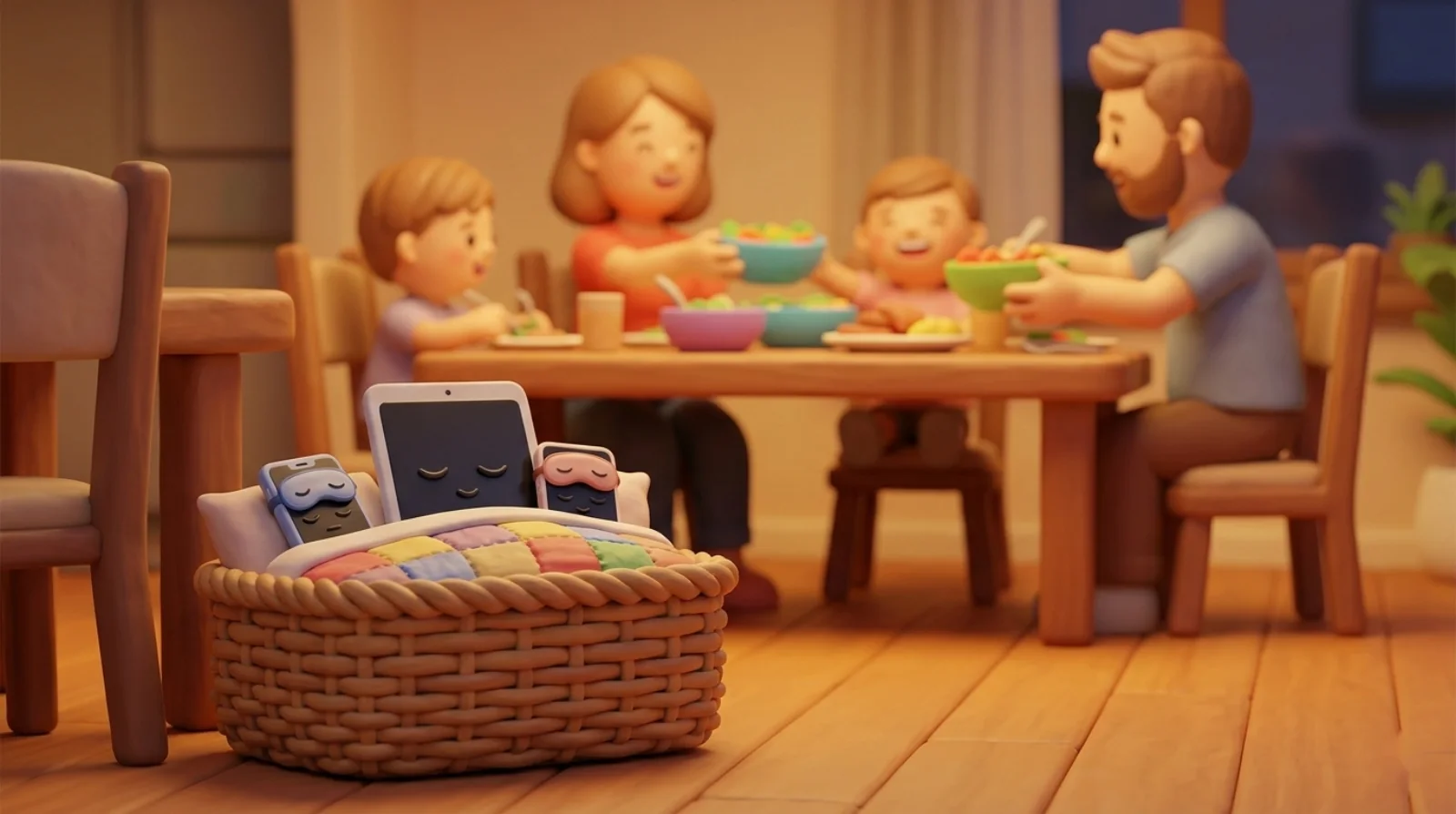
- Screen-free zones: keep the dinner table and bedrooms screen-free. Not as punishment — as architecture. When screens aren’t physically present, there’s nothing to negotiate.
- Screen-free times: turn screens off 1–2 hours before bed. Blue-enriched light from screens suppresses melatonin in children, and stimulating content raises arousal — both making falling asleep harder. Children’s eyes transmit blue light more readily than adults’, making them especially sensitive.4
- One screen at a time: turn off devices that aren’t in active use. Background screens create a low-grade hum of distraction that nobody notices until it’s gone.
- Transition warnings: “Five more minutes” works better than “stop now.” A countdown timer the child can see — on the microwave, on a kitchen clock — works better still. The meltdown isn’t about the screen. It’s about the surprise of losing it.
- Co-view when you can: watching together turns screen time into shared time and helps younger kids process what they see.
Quality over quantity
Not all screen time is equal. And this is where I think the guilt can ease a little.
Sunday afternoon. A nature documentary is on. Your child is tucked under your arm, pointing at a whale shark on the screen. “Why is it so big? Does it eat people?” You laugh. You don’t know the answer. You look it up together. The screen is on for an hour and nobody feels bad about it — because you’re there, and the content is doing something: sparking questions, building vocabulary, creating a memory.
That hour is fundamentally different from an hour of autoplay algorithm content watched alone in a bedroom.
Choose content that teaches, sparks curiosity, or encourages connection. Avoid violent or age-inappropriate material — not because you need to be perfect, but because the difference between intentional and passive screen time is enormous, and it’s a difference you can feel.
Pause
If you’re reading this at 11 PM with one eye closed — bookmark it. Come back when you have coffee. None of this needs to happen tonight.
Your phone is on the table too
Here’s the angle I think most screen time articles skip: rules that don’t include parents are rules that children can smell as unfair.
Your child watches you. They watch you check your phone at dinner. They watch you scroll in bed. They watch you say “one second” and then disappear into a notification for five minutes. They don’t have the vocabulary to call it hypocrisy, but they feel it in their body — a tightening, a sense that the rules are rigged.
Shared rules mean shared rules. If the dinner table is screen-free, your phone goes face-down too. If screens are off before bed, yours is charging in the kitchen. This isn’t about being perfect. It’s about being consistent — and about the quiet respect your child feels when the rules apply to everyone.
A 2018 study in the Journal of Social and Personal Relationships found that “technoference” — parental phone use during family interactions — was associated with greater child behavior problems, not because the phone itself was harmful, but because children experienced the distraction as withdrawal.5
Model what you preach. Not because you should. Because it works.
Your family screen agreement
You don’t need a contract. You need a conversation — and then something visible. A piece of paper on the fridge. A note in a shared app. Something every caregiver can see without asking.
| Rule | Our family agreement |
|---|---|
| Morning screens | _____ (e.g., “after breakfast + dressed”) |
| After school | _____ (e.g., “30 min after homework”) |
| Before bed | _____ (e.g., “screens off at 7 PM”) |
| Weekend | _____ (e.g., “1 hour, then outside time”) |
| Screen-free zones | _____ (e.g., “dinner table, bedrooms”) |
| Parent screens | _____ (yes, this row matters) |
Fill this in together — with your partner, with your kids if they’re old enough. The act of filling it in is half the point. Rules that people help create are rules people follow.
How to build a family media plan
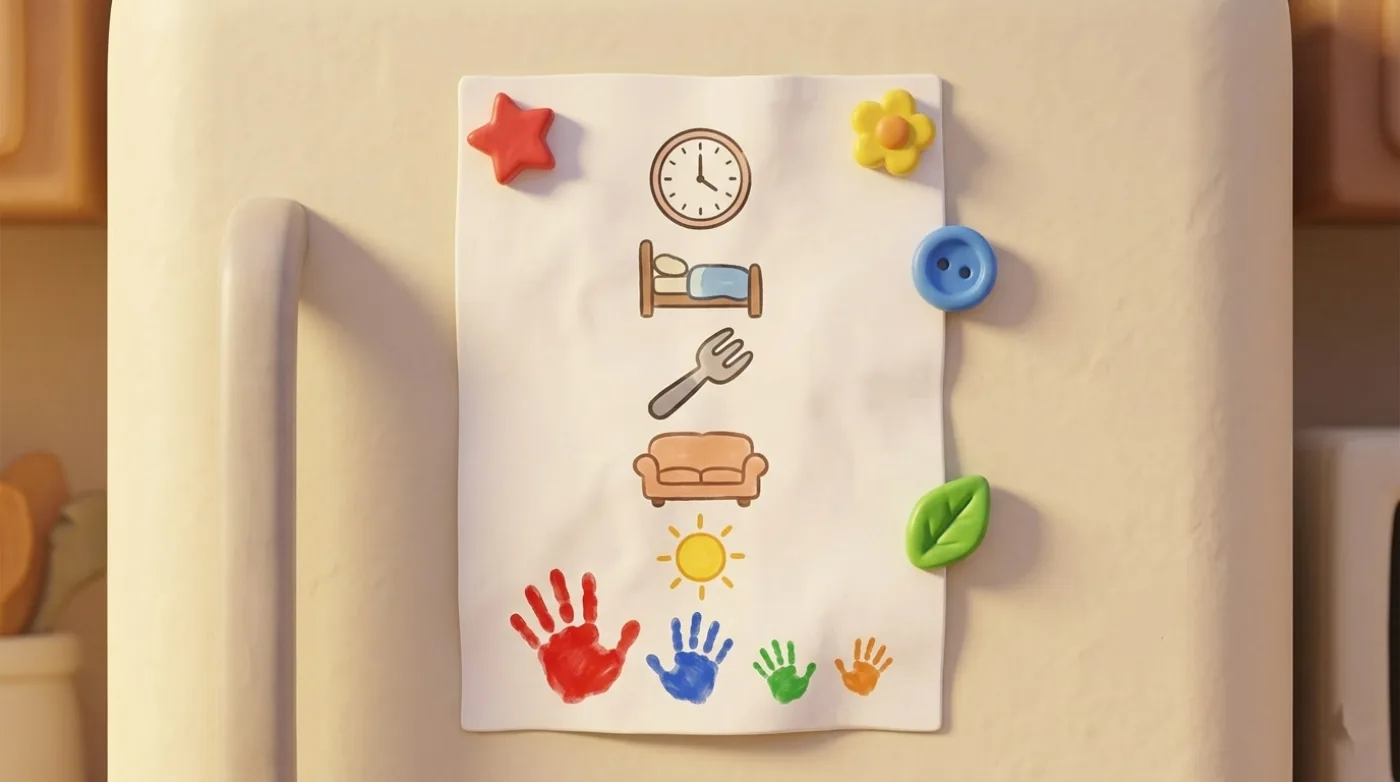
A family media plan is a shared agreement on when, where, and how screens are used. To make one that sticks:
- Match it to your kids’ ages and real routines — a plan that ignores your Tuesday chaos won’t survive Wednesday.
- Decide screen-free zones and times together, so kids have ownership.
- Model it yourself — kids notice when adults follow the same rules.
- Write it down and keep it visible — a plan everyone can see is easier to follow than one in your head.
- Revisit it as kids grow and needs change — what works at five won’t work at ten.
You don’t have to do all of this at once. One small step is enough.
Start here
Tonight, set one screen-free zone: the dinner table. No phones — yours included. That’s it. No lecture, no new rules, no app, no printout. Just dinner without screens.
If it feels weird, that’s information. If your child asks why, tell them. If your partner forgets, remind them gently. If you forget, notice that too.
One dinner. That’s the whole assignment.
Make the agreement visible to every caregiver
Screen time rules break when only one parent enforces them — or when the “plan” lives in one person’s head. Mom says no screens before breakfast. Dad doesn’t know that rule exists. Grandma has a completely different policy on Wednesdays. The child learns, quickly, that rules are negotiable depending on who’s in the room.
Rules work when every caregiver sees the same agreement — not because they memorized it, but because it’s visible.
That’s one thing a morning on the couch, a kitchen table, a shared screen: they all have in common. The child reaches for a book instead of the tablet — not because of a rule, but because the routine is just… different now. The cereal is already out. The milk is in the fridge where it belongs. Something shifted, not dramatically, but enough.
ParentOS, the adaptive family operating system I’m building, is privacy first — no ads, and your data is never sold. Screen-free times, routines, and daily rhythm in one shared place that both parents and other caregivers can see. When everyone follows the same plan, rules stop being a daily negotiation. If you’re looking for a calmer way to organize family life — join the early access.
A note on privacy
When choosing apps to manage screen time or family schedules, consider where your family’s data goes. Free apps often monetize through advertising and data collection — including information about your children’s habits and routines. I’d look for tools that are transparent about how they handle data, and that treat your family’s information as private by default.
Frequently asked questions
How much screen time should a 2-year-old have? The AAP recommends limiting children aged 2–5 to about one hour per day of high-quality programming, ideally watched together with a parent.1
Is screen time bad for babies? For children under 18 months, the AAP recommends avoiding screens other than video chatting, and prioritizing sleep, play, and interaction.1
How much screen time for older kids and teens? For ages 6 and up, the AAP focuses on consistent limits and balance rather than a single number — making sure screens don’t displace sleep, physical activity, and family time.1
What is a family media plan? A family media plan is a shared agreement covering when, where, and how your family uses screens — including screen-free zones and times — tailored to your children’s ages and routines.
Sources
Related articles
Calm families start with shared awareness.
Footnotes
-
American Academy of Pediatrics — screen time and media use recommendations, via HealthyChildren.org Family Media Plan and AAP policy guidance (updated 2024 to emphasize quality, context, and balance over strict time limits). healthychildren.org/English/fmp/Pages/MediaPlan.aspx ↩ ↩2 ↩3 ↩4 ↩5
-
World Health Organization (2019). Guidelines on Physical Activity, Sedentary Behaviour and Sleep for Children under 5 Years of Age. WHO, Geneva. who.int ↩
-
Madigan S., Browne D., Racine N., Mori C., Tough S. (2019). Association Between Screen Time and Children’s Performance on a Developmental Screening Test. JAMA Pediatrics, 173(3), 244–250. doi:10.1001/jamapediatrics.2018.5056. jamanetwork.com ↩
-
Lee S.I. et al. (2018). Melatonin suppression and sleepiness in children exposed to blue-enriched white LED lighting at night. Physiological Reports, 6(24), e13942. pubmed.ncbi.nlm.nih.gov/30554482 ↩
-
McDaniel B.T., Radesky J.S. (2018). Technoference: Longitudinal Associations Between Parent Technology Use, Parenting Stress, and Child Behavior Problems. Pediatric Research, 84, 210–218. doi:10.1038/s41390-018-0052-6. ↩