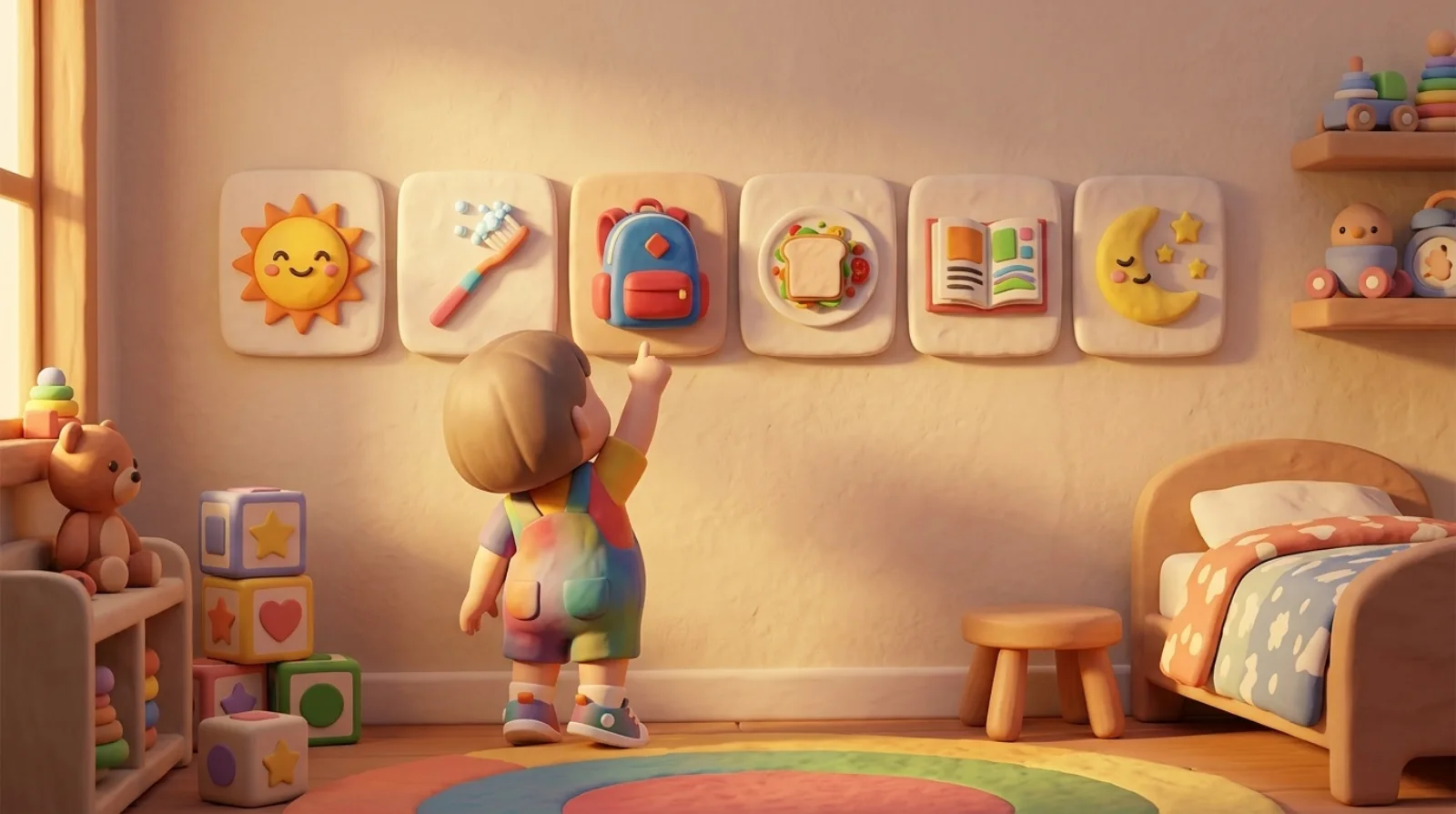
Visual Schedule for Kids: How to Build One That Works (ADHD & Autism)
TL;DR: A visual schedule replaces spoken instructions (which vanish the moment you say them) with pictures that stay visible — so your child can “read” the sequence on their own. It’s recognized as an evidence-based practice for autism1 and linked to better transitions, more independence, and fewer meltdowns for ADHD.2 Tonight: draw 5 morning icons on a piece of paper, tape it to your child’s bedroom door, and ask “What comes after the plate?” They’ll know.
7:12 AM. Hallway. Shoes by the door.
Two sneakers — but which pair? The backpack is somewhere behind the couch. Your child stands in the middle of the floor, one sock on, cereal bowl still on the table, staring at nothing.
You’ve said “get dressed” three times. Your voice is getting that edge you don’t like. The clock on the microwave blinks a number you’d rather not see.
They’re not defiant. They’re not ignoring you. They’re lost.
Because in their head, there’s no sequence — just noise. A cloud of things that all need to happen, without any order, without a starting point. You can see the morning: toast, teeth, shoes, door. They can’t. Not because they won’t. Because nobody showed them the map.
As a parent of neurodivergent kids, this is how I think of a visual schedule. Not a reward chart. Not a to-do list. A map — where the child can see what’s happening now, what comes next, and what “done” looks like.
The map, not the instruction
Here’s the thing about spoken instructions: they disappear. The moment the words leave your mouth — “brush your teeth, then get dressed, then grab your backpack” — they’re gone. An adult can hold a three-step chain in working memory. A five-year-old can’t. A child with ADHD or autism especially can’t, because their working memory is already full of the tag on the shirt that scratches, the sound of the dishwasher, the light coming through the window at a weird angle.
A visual schedule turns the invisible into visible. Instead of “remember what I told you,” it’s “look at the wall.” The sequence stays. The child moves through it at their own pace. No one needs to repeat anything.
This is why the research is so consistent. The National Professional Development Center on Autism Spectrum Disorders (NPDC on ASD) — one of the most comprehensive evidence reviews in the field — recognizes visual supports as an evidence-based practice for students with autism.1 Their review of over 29,000 articles identified visual schedules among 27 interventions with strong enough evidence to earn that label.
Peer-reviewed literature confirms what parents see at home: visual schedules significantly improve behavioral outcomes, with studies showing reductions in problem behaviors such as tantrums and non-compliance, especially during transitions.2 For students with emotional and behavioral disorders, visual activity schedules reduce disruptive behaviors during transitions and integrate smoothly into existing routines.3 For children with ADHD and developmental delays, visual schedules increase task engagement, improve on-task behavior, and support social skills.2
My short version: the pictures work because they’re there. Your words work too — but only while they’re still in the air.
How to build one: step by step
1. Pick one routine to start
Don’t map the whole day. Choose the routine that causes the most friction — mornings, after school, or bedtime — and start there. One routine. One strip of pictures.
2. Break it into a short sequence
List the concrete steps in order. A morning routine might be: wake up → get dressed → breakfast → brush teeth → shoes → out the door. Keep it short. Too many steps overwhelm — and an overwhelmed child stops looking at the wall.
3. Use one clear image per step
A simple icon, a clipart drawing, or a real photo of your own child doing the step. The image should be obvious at a glance. No ambiguity. Plate means breakfast. Toothbrush means teeth. Door means go.
For younger children or kids who respond better to concrete images, photos of them doing the task work especially well.
4. Put it where the routine happens
At the child’s eye level. Not yours — theirs. By the front door for mornings. In the bathroom for bedtime. If it’s not in the place where the routine starts, it doesn’t exist.
5. Walk through it together — and let them move the pieces
To me, this is the part that makes it theirs. Walk through the schedule together the first few times. Let the child move a magnet, flip a card, or check off each step. That click — that small physical action — is what turns “your plan” into “my sequence.”
A child walks to the fridge. Points at the picture card — plate means breakfast. Eats. Comes back. Moves the magnet to “done.” Click. Looks at the next card. Toothbrush. Goes to the bathroom without being told.
That click of the magnet is the sound of a child who knows what to do next.
6. Keep it consistent
The power is in repetition. The more the same sequence repeats in the same place, the more the schedule becomes background — a signal the child’s body follows before their brain catches up. Eventually they won’t need to look at it. But it needs to be there long enough to become automatic.
Your 5-step morning visual schedule (print this)

| Step | Picture | Action |
|---|---|---|
| 1 | 🛏️ | Get up |
| 2 | 🍽️ | Breakfast |
| 3 | 🪥 | Brush teeth |
| 4 | 👕 | Get dressed |
| 5 | 🎒 | Backpack + shoes |
| 6 | 🚪 | Out the door |
Swap in your own steps and images. I’d argue the format matters more than the exact icons — what matters is that the sequence is visible and consistent.
When it stops working
The schedule fell behind the fridge. It slid down one morning when someone opened the door too fast, and it landed in the gap between the fridge and the wall. Nobody noticed. A week went by. The mornings got louder again.
That’s the answer to “why did it stop working?”
In my view, a schedule rarely fails because the child outgrew it or because it was the wrong approach. It fails because it disappeared. It became invisible — which is the one thing a visual schedule can never be.
If it stopped working, check these first:
- It’s out of sight → move it back to where the routine happens, at eye level. If it fell, put it back up. Literally.
- Too many steps → trim to the essentials. Five is plenty. Three is fine.
- Steps changed but the schedule didn’t → update it so it matches reality. A schedule that shows the wrong sequence is worse than no schedule.
- Child ignores it → walk through it together again. Point. Ask “what’s next?” Make checking off satisfying — magnets, stickers, a small flip.
And if today isn’t the day — that’s okay too. The schedule will be there when you’re ready to put it back up.
Start here — tonight
Tonight, draw 5 morning icons on a piece of paper: bed, plate, toothbrush, coat, door. Tape it to your child’s bedroom door. Tomorrow morning, point at the first one and say: “What comes after the plate?”
They’ll know.
You don’t need laminating supplies. You don’t need an app, and I say that as someone who builds one. You need a piece of paper, a marker, and tape. That’s step one. Everything else — colors, magnets, photos — is step two. Don’t skip step one by planning step two.
When paper stops being enough
Laminated cards work. They work well. Until the schedule needs to travel — to grandma’s house, to the sitter, to dad’s apartment after the weekend.
Grandma picks up the child after school. She pulls out her phone and sees the same afternoon sequence: snack, homework, play, dinner, bath. The child doesn’t protest because the afternoon looks the same regardless of whose hands guide it. No negotiation. No “but mom lets me.” The map is the map.
A schedule that only lives on your fridge depends on your fridge. A schedule that every caregiver can see is a schedule that doesn’t depend on your memory.
ParentOS, the family organization app I build to reduce the mental load of parenting, brings this same idea into the family’s shared space: routines appear as clear, tappable steps the child can follow and check off, while parents, grandparents, and sitters all see the same plan — wherever they are. The structure your child relies on stays consistent, no matter who’s on duty.
ParentOS has no ads and never sells your family’s data. If you’re looking for a calmer way to organize family life, join the early access.
Frequently asked questions
Do visual schedules help children with ADHD? Yes. Research finds visual schedules increase task engagement and on-task behavior and support social skills in children with ADHD and developmental delays.2
Are visual schedules evidence-based for autism? Yes. Visual supports, including visual schedules, are recognized as an evidence-based practice for children with autism by the National Professional Development Center on ASD1 and are supported by multiple peer-reviewed literature reviews.2
At what age can I use a visual schedule? Visual schedules work well from the preschool years onward, and are especially useful for children who can’t yet read or who struggle with transitions, since they rely on pictures rather than words.
How many steps should a visual schedule have? Start small — focus on one routine and just its essential steps. Five or six is a good ceiling. Too many steps can overwhelm a child and reduce the schedule’s usefulness.
Sources
Related articles
- Baby Sleep Schedule by Age
- Chore Chart by Age
- Screen Time Rules for Kids
- Time Blindness & Visual Timers for ADHD Families
Calm families start with shared awareness.
Footnotes
-
National Professional Development Center on Autism Spectrum Disorders (NPDC on ASD) — Evidence-Based Practices for Autism. Frank Porter Graham Child Development Institute, UNC Chapel Hill. autismpdc.fpg.unc.edu — comprehensive review of 29,000+ articles identified visual supports as one of 27 evidence-based practices for autism spectrum disorder. ↩ ↩2 ↩3
-
The use of visual schedules to increase academic-related on-task behaviors of individuals with autism: a literature review. International Journal of Developmental Disabilities (Taylor & Francis), 2024. doi:10.1080/20473869.2024.2402124 — literature review concluding that visual schedules, especially combined with prompting, improve academic on-task behavior in individuals with autism. ↩ ↩2 ↩3 ↩4 ↩5
-
Milam M.E., Sutton K.K. (2024). Using Visual Activity Schedules to Improve Transitioning for Students With Emotional and Behavioral Disorders. Beyond Behavior (SAGE Journals). doi:10.1177/10742956241276003 — practical guide showing how visual activity schedules reduce disruptive behavior during transitions in students with EBD. ↩