Family Screen Plan: How to Create Rules That Actually Work (Without Daily Fights)
Pillar: Slow Tech | Reading time: ~5 min Current as of: March 2026
Daily fights over screens don’t have to be normal. The American Academy of Pediatrics recommends a Family Media Plan — rules you agree on together that apply to the WHOLE family (yes, parents too). Below: a ready-to-print template, 5 questions to settle with your partner, and one surprising finding from the research.
”Turn off the tablet!” “Five more minutes!”
“I said NOW!”
“But Dad’s on his phone and nobody says anything to him!”
…Silence. Because the kid is right.
Most parents know this exchange. Maybe not in these words, but in the same dynamic: one parent enforces, the other looks at their own screen, the child sees the unfairness. And suddenly it’s not about the tablet anymore. It’s about the rules not being shared.
Screen rules that apply only to kids don’t work. Rules that apply to the WHOLE family do.
Why “2 hours max” doesn’t work
For years we heard one simple recommendation: no more than 2 hours of screen time a day. Sounds reasonable. In practice, it doesn’t work.
In 2026 the American Academy of Pediatrics updated its recommendations. It moved away from rigid time limits toward the “5 C’s” framework: Child, Content, Calming, Crowding out, and Communication. Quality, context, and conversation matter more than minutes on the clock.
An hour of Minecraft with Dad is not the same hour as scrolling TikTok in bed. It’s not the same “screen time.” And the “2 hours max” rule can’t tell one from the other.
In 2017 Andrew Przybylski and Netta Weinstein of the University of Oxford studied 120,115 English teenagers. Their conclusion: moderate use of technology isn’t harmful and may even be beneficial. The negative effect of excessive use was about 1% — comparable to a third of the effect of good sleep. The National Academies of Sciences confirmed it in 2024: “the relationship is far more complex than it seems.”
The problem with “2 hours max” is simple: the child counts minutes, the parent watches the clock, everybody gets upset. No conversation about WHAT the child is watching. No agreement between partners. No consistency.
Stop counting minutes. Start talking about what your child actually does on a screen.
5 questions instead of 5 bans
The AAP recommends creating a Family Media Plan — a shared plan for the whole family. It isn’t a list of bans. It’s 5 questions you answer TOGETHER: with your partner and with your kids (as fits their age).
1. WHEN do screens GO AWAY?
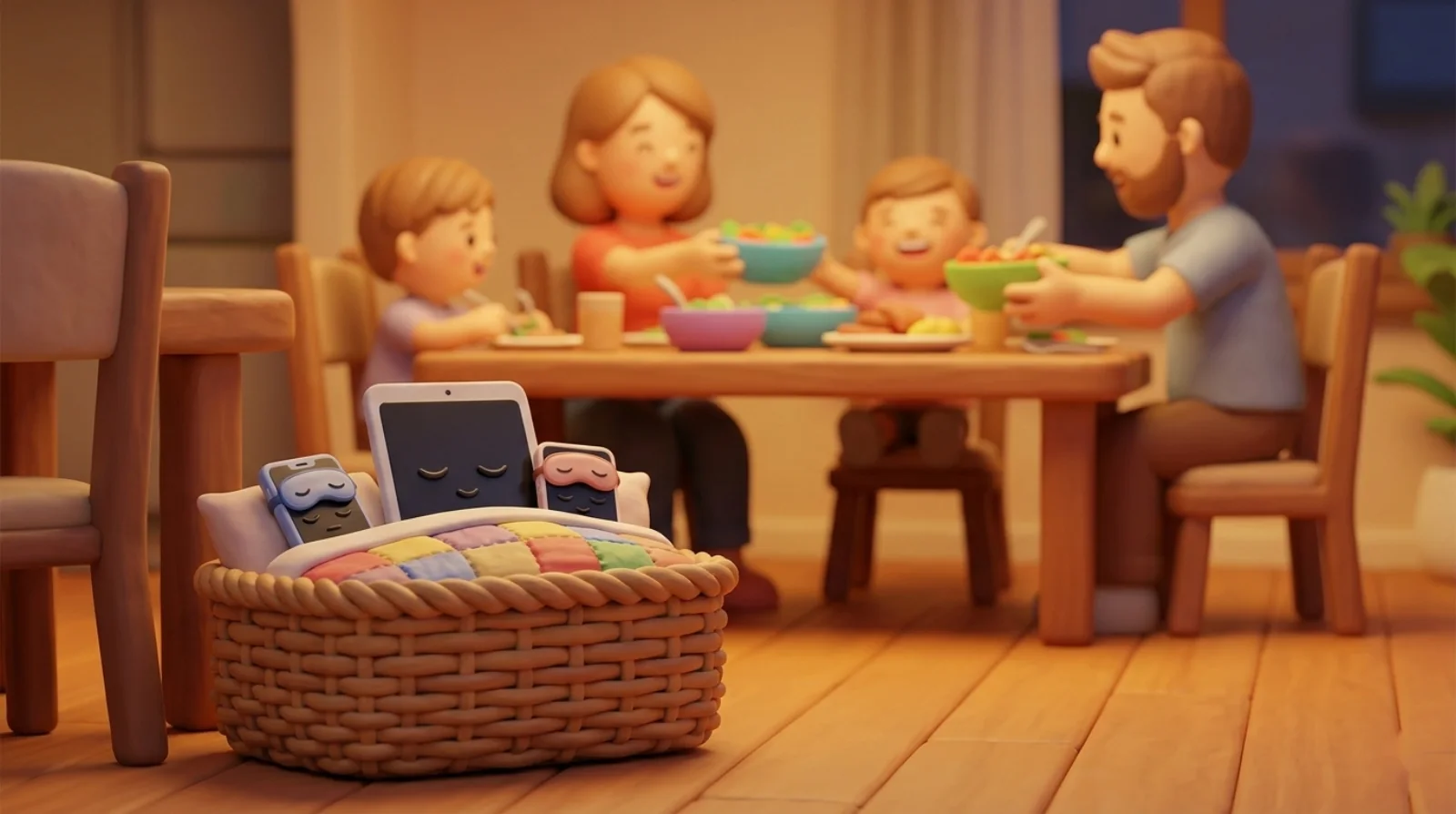
Agree on the moments when phones and tablets disappear. For example: meals, conversations, the bedroom after 8:00 PM, car rides.
This isn’t a philosophical question. It’s a logistical one. A phone on the table at dinner changes the dynamic of the conversation — even if nobody touches it.
Research on technoference — technology interrupting parent-child interaction — shows that 65% of mothers report their own phone interrupting playtime with their child. Kids react: more whining, more frustration, more outbursts (McDaniel and Radesky, 2018).
2. WHAT is OK, and what isn’t?
YouTube Kids — yes. TikTok — no. Playing a game together — yes. Scrolling in bed — no. Every family draws these lines differently.
In its 2023 report, the APA emphasizes that different features of social media have different effects. A blanket ban (“no screens at all”) doesn’t work better than a conscious choice. Personalization matters more than a general prohibition.
3. TOGETHER or alone?
Watching together on the couch — OK. A tablet alone in the bedroom — only from a certain age.
This may be the most important question. An analysis of 88 studies published by Elsevier in 2025 found that using media together (co-use) has the BIGGEST positive effect on a child’s development. Not “zero screens.” Not “keep it to a minimum.” Using it together.
When you sit down with your child and watch something on a screen together, you do three things at once: you keep an eye on the content, you build the relationship, and you teach critical thinking.
4. What do we do INSTEAD?
Put together a shared “list of alternatives”: a board game, a walk, reading, building blocks, drawing, baking. The list doesn’t have to be long. It just has to exist.
When a child hears “no” to the tablet, the next question is “so what can I do?” If you don’t have an answer, you’re back to negotiating. If the list is hanging on the fridge, the child picks for themselves.
In its 2019 guidelines, the WHO emphasizes that physical activity matters more than restricting screens. At least 180 minutes of activity a day for children ages 1-4. The point isn’t to throw out the tablet. The point is that the tablet shouldn’t crowd out movement.
5. What do we do when the rules get broken?
Because they will. That’s a given.
Not punishment — a conversation. “I noticed there was more screen time today than we agreed on. What do you think? What happened?”
Calm matters more than alarm. A conversation works better than a punishment. A child who knows that breaking a rule leads to a talk (not yelling) will find it easier to tell you when something has gone wrong.
Pause
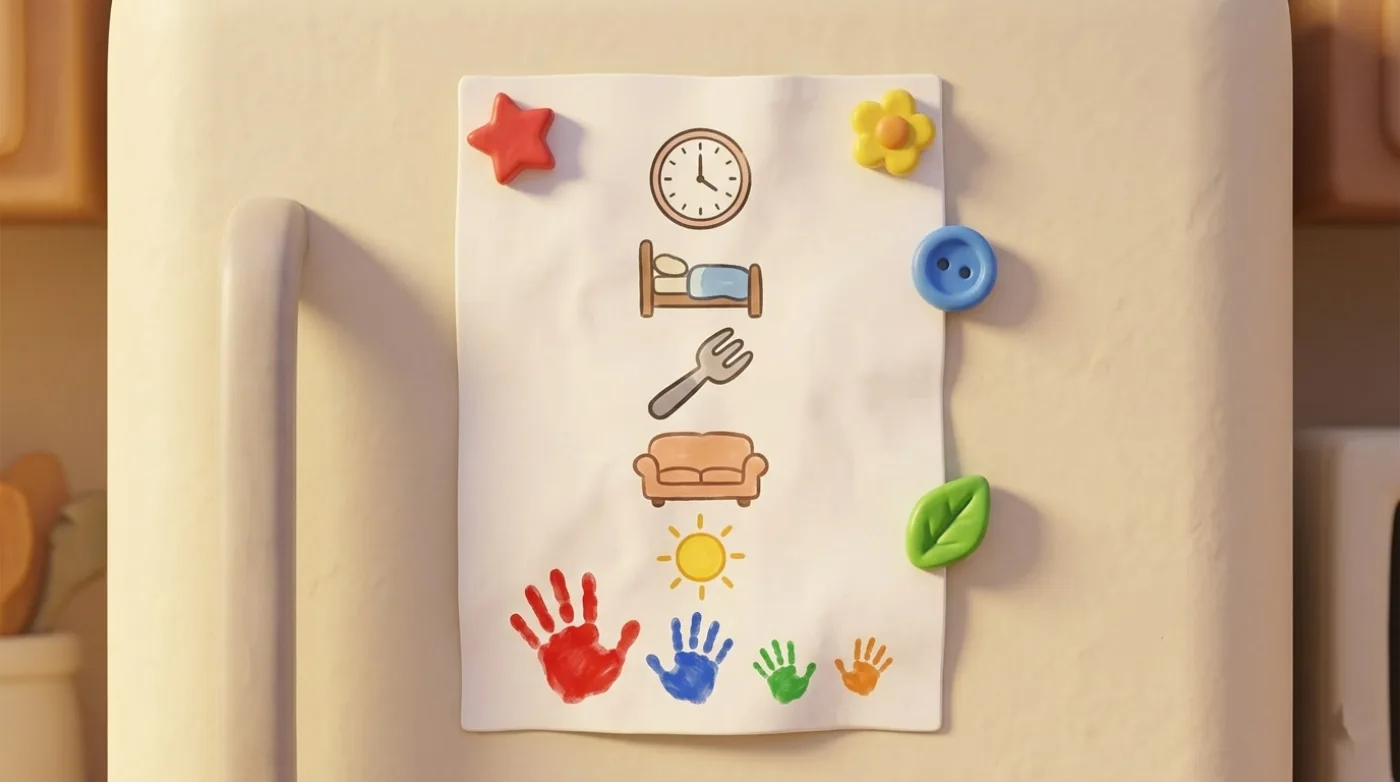
These 5 questions don’t need perfect answers. They need SHARED answers. Ones that you, your partner, and your child all know. Ones that are written down and visible — not just in one parent’s head.
A ready-to-print template
You can print this and hang it on the fridge. Or copy it onto a sheet of paper. Or just talk it through over coffee on the weekend while the kids play. The format doesn’t matter — what matters is that both parents know the answers.
Open the interactive version of the screen plan → — fill it in online and print a finished PDF (the interactive version is in Polish).
+----------------------------------------------------------+
|              OUR FAMILY SCREEN PLAN                      |
+----------------------------------------------------------+
|                                                          |
|  Agreed on by: ______________ and ______________         |
|  Date: ______________                                    |
|                                                          |
|  SCREENS GO AWAY:                                        |
|  [ ] Meals                                               |
|  [ ] Conversations                                       |
|  [ ] Bedroom after ___                                   |
|  [ ] Car                                                 |
|  [ ] _______________                                     |
|                                                          |
|  WHAT'S OK:                                              |
|  _____________________________________________________   |
|  _____________________________________________________   |
|                                                          |
|  WHAT'S NOT OK:                                          |
|  _____________________________________________________   |
|  _____________________________________________________   |
|                                                          |
|  TOGETHER (what we do on a screen together):             |
|  _____________________________________________________   |
|                                                          |
|  INSTEAD OF SCREENS (our list):                          |
|  1. _______________                                      |
|  2. _______________                                      |
|  3. _______________                                      |
|  4. _______________                                      |
|  5. _______________                                      |
|                                                          |
|  WHEN THE RULES GET BROKEN:                              |
|  _____________________________________________________   |
|  _____________________________________________________   |
|                                                          |
+----------------------------------------------------------+
A tip: don’t try to fill in everything the first time. Start with “SCREENS GO AWAY” — it’s the easiest part. The rest can come over the following weeks.
The surprising finding: start with YOURSELF
The hardest part of a Family Media Plan isn’t about the kids. It’s about you.
Research on technoference shows that a parent’s phone use lowers their responsiveness to their child. We talk less, gesture less, and react more slowly to a child’s signals — even when we don’t realize it.
If your phone is on the table at dinner, your child sees that the rules apply only to them. And they’re right.
Research published in Frontiers in Psychology (2024) shows that feeling guilty about your own phone use doesn’t help — it can lead to lower mood. A better solution: set rules that apply to EVERYONE. And stick to them. Instead of feeling guilty, act.
Your micro-step for today
Tonight, at dinner, suggest:
“What if we came up with screen rules together? Ones that apply to EVERYONE — including me and Dad/Mom.”
Listen to what the kids say. You may be surprised by how willingly they join the conversation — and how on point their ideas are.
You don’t need a finished plan. It’s enough to start the conversation.
ParentOS was designed around shared awareness — one glance at the day. No surprises. If you’re curious — parentos.ai
Read also
- The Phone Can Wait: Why 145,000 Families Promised Each Other Not to Give Kids Smartphones — why 145,000 families promised not to give their kids smartphones until 8th grade
- Slow Parenting 2.0: How Technology Can Help You Slow Down (Instead of Speeding Up) — 5 principles of calm parenting in the digital age
- Generation Beta: Your Child Will Be Born Into a World Where AI Already Exists. And That’s OK. — a practical guide for parents
FAQ
At what age should kids start helping make the rules?
Kids as young as 4-5 can take part in simple agreements (“when do we watch a cartoon?”). From 7-8 they can actively help build the plan. Teenagers HAVE to be part of the conversation — rules handed down from above won’t be followed.
What if my partner doesn’t want to limit screens?
Start with one rule you both agree on. For example: “no phones at dinner.” That’s a starting point, not the end of the conversation. If your partner doesn’t see a problem, don’t try to convince them. Start by putting your own phone away at dinner. The kids will notice. So will your partner.
Should weekends have different rules?
They can, but they don’t have to. Many families loosen the rules on weekends — and that’s OK, as long as it’s AGREED ON and not just “the result of being too tired to care.” Write the weekend into the plan. “Saturday morning: cartoons until 9:00” is a rule too. A better one than “well, it’s the weekend, so…”
How do I explain the rules to grandparents?
Give them a copy of the plan. Don’t explain, don’t persuade — show them the document. “These are our family rules. Now you’ll know what’s OK.” Grandparents often feel unsure because they don’t know what “today’s” rules are. A ready-made plan takes that weight off them.
Sources
- AAP, “Updated Screen Time Recommendations: 5 C’s Framework” (2026) — edsurge.com
- AAP, “Family Media Plan” (2016, updated since) — healthychildren.org
- Przybylski, A. K. & Weinstein, N., “A Large-Scale Test of the Goldilocks Hypothesis,” Psychological Science 28(2), 204-215 (2017) — DOI
- National Academies of Sciences, “Social Media and Adolescent Health” (2024) — nationalacademies.org
- McDaniel, B. T. & Radesky, J. S., “Technoference: Parent Distraction with Technology,” Child Development 89(1) (2018) — PMC
- “Smartphones in the Nursery: Parental Smartphone Use and Parental Sensitivity,” scoping review (2021) — PMC
- APA, “Health Advisory on Social Media Use in Adolescence” (2023) — apa.org
- WHO, “Guidelines on Physical Activity, Sedentary Behaviour and Sleep for Children under 5” (2019) — who.int
- U.S. Surgeon General, “Advisory on Social Media and Youth Mental Health” (2023) — hhs.gov
- NASK (Poland’s national research institute for internet safety), “Nastolatki 3.0” (“Teenagers 3.0”) (2022) — nask.pl
- Cal Newport, Digital Minimalism (2019) — calnewport.com