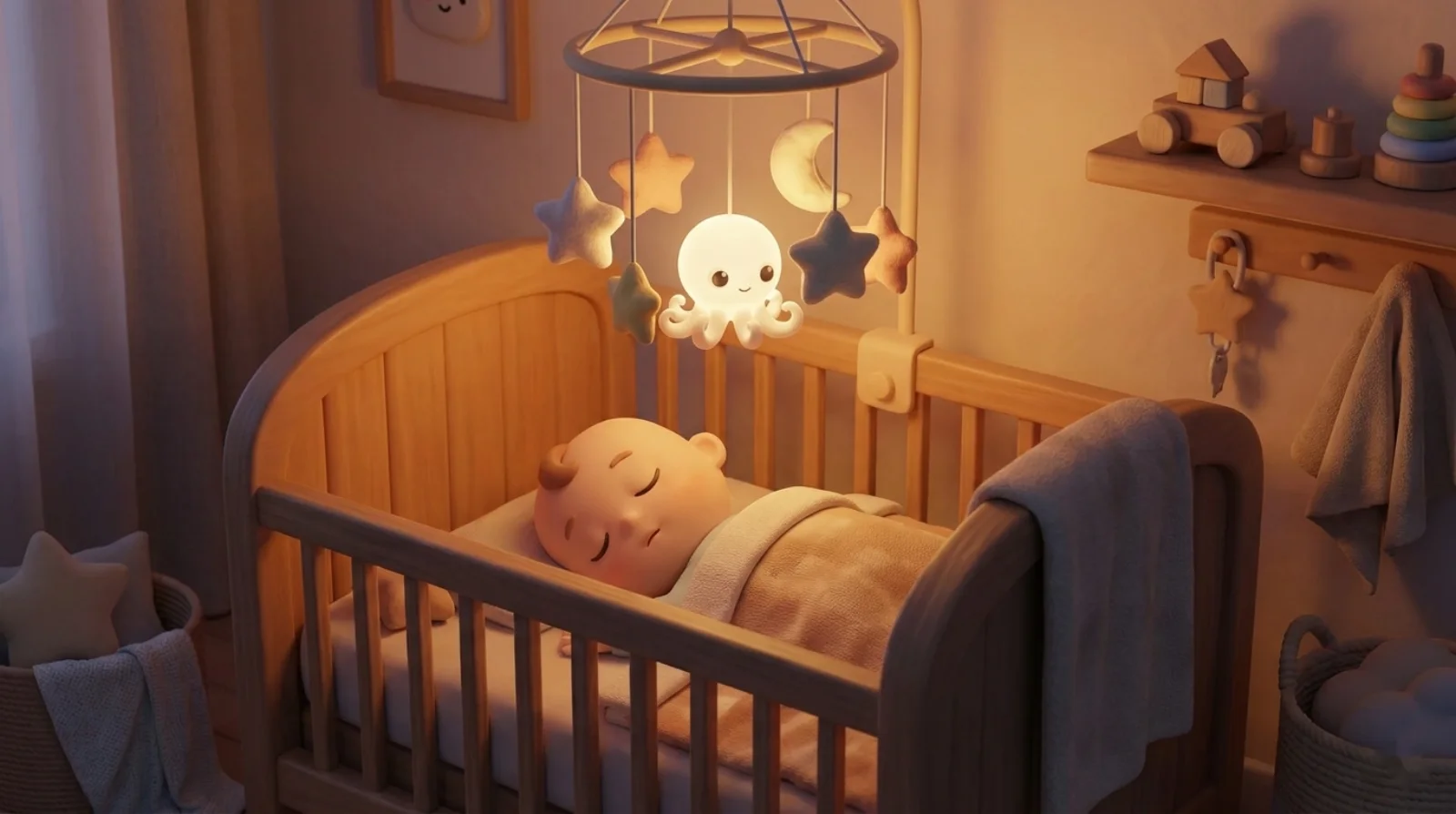
Generation Beta: Your Child Will Be Born Into a World Where AI Already Exists. And That's OK.
Pillar: Slow Tech | Reading time: ~5 min As of: March 2026
Generation Beta (children born from 2025 onward) is the first generation for whom AI is a natural part of reality — the way electricity or the internet was for their parents. They don’t need lectures about AI. They need parents who understand the world they’re growing up in — and who can walk alongside them calmly.
Your child will never know a world without AI
A child born in 2025. Before they start school, AI will be in every device, every app, every search. They won’t wonder “what is AI” — just as you don’t wonder “what is the internet.” It’s simply there.
A voice assistant in the kitchen answers questions. A learning app adjusts to your child’s pace. A toy responds to emotions. This isn’t science fiction. It’s a Thursday.
Is that scary? No. But it calls for a different kind of parenting than the one we know.
What is Generation Beta?
Generation Beta is the children born from 2025 to around 2039. The successors to Generation Alpha (2010-2024), the grandchildren of Gen Y, the great-grandchildren of Gen X.
The key difference is simple.
Generation Alpha watched AI arrive. ChatGPT appeared in 2022, when the oldest Alpha kids were 12. For them, AI was something new — something that happened.
Generation Beta was born into a world where AI already exists. For them there’s no “before” and “after.” There’s only “now.”
It’s the same difference as the one between Gen Z and smartphones. Gen Z remembered a world without smartphones. Generation Alpha didn’t. Now the same leap is happening with AI.
UNESCO, in its AI Competency Framework (2024), points out that the ability to work with AI is a new foundational skill — like reading, writing, or arithmetic [6]. Not an extra. Foundational.
You don’t have to treat this as a threat. You can treat it as a fact.
What’s really changing?
Not speculation. Not movie plots. Real changes that are already happening or will start within the next few years.
School
The EU AI Act classifies AI systems in education as “high-risk” — which means strict safety requirements [8]. Teachers use AI to prepare lessons. According to the Stanford HAI report (2025), 81% of computer science teachers believe AI should be part of education, but fewer than half feel ready to teach it [5].
Your child will learn with AI, not about AI. That’s a difference.
Play
AI-powered toys aren’t the future — they’re the present. Robot pets that respond to touch. Games that adjust to a child’s level. Research from the MIT Media Lab shows that children attribute mental states to robots and form emotional relationships with them [9]. They treat them as something more than objects.
Health
AI in diagnostics, AI health assistants, AI that monitors a child’s sleep. Before your child turns 10, they’ll probably ask AI about their health — not Google.
Relationships
This is the hardest one. The OECD, in its Children & AI Design Code, warns: children form relationships with AI that doesn’t return their feelings [7]. Research from 2024-2025 indicates that children form stronger emotional attachments to chatbots than adults do [10]. AI communicates in an empathetic, validating way — but it doesn’t understand what it’s saying.
You don’t have to understand every technology. You have to understand your child.
Breathe.
This isn’t the apocalypse. It’s evolution. Your parents didn’t know what to do about the internet either. And somehow you managed.
5 principles for parenting Generation Beta
1. Presence > control
Be with your child as they discover technology. Not behind them. Not over them. Beside them.
The AAP, in its updated 5 C’s framework (2026), shifted the emphasis from restriction to communication [2]. Not “how many minutes of screen time,” but “are we talking about what we see.” Watching together, asking together, discovering together.
When you and your 4-year-old ask a voice assistant “why is the sky blue?” — listen to the answer together. You don’t have to run a “critical thinking lesson.” It’s enough that you’re on the same couch.
2. Questions > answers
AI will give answers. Fast, smooth, without hesitation. Your job is to teach asking.
“How do you know that?” “Is that true?” “Who wrote this?” “What would happen if it were the other way around?”
UNESCO names critical thinking as the key to AI literacy [6]. The point isn’t for your child to know how a neural network works. The point is that they don’t accept every answer as the truth.
3. Emotions > algorithms
AI doesn’t understand emotions. It simulates them. Your child will talk to systems that respond with empathy — but don’t feel what they say [10].
Talk about feelings. Name them. “I can see you’re angry.” “That was frustrating, wasn’t it?” “What do you feel in your tummy when you’re scared?”
Mitch Resnick of MIT emphasizes that creativity and emotions are skills AI won’t replace [11]. But they need practice. Every day. In conversations that have no “right answer.”
4. Calm limits > panicked bans
Set boundaries. Without the drama.
“We’re putting the tablet away now” — that’s a limit. “TURN THAT OFF RIGHT NOW BEFORE YOUR BRAIN ROTS!” — that’s panic.
The WHO (2019) recommends screen limits [1]. But Przybylski’s study at Oxford (a sample of 120,000 teenagers) found that moderate use of technology isn’t harmful [3]. The relationship is shaped like an inverted U — like most things in life. Not too little, not too much. And quality matters more than minutes.
A calm limit works better than a panicked ban. Every time.
5. Forgive yourself > be perfect
There’s no such thing as the “perfect digital parent.” There’s “good enough.”
Przybylski’s Goldilocks study has one more finding that hardly anyone talks about: the negative effect of excessive screen use is about 1% of the variance — comparable to one third of the effect of good sleep [3]. In other words: putting your child to bed at a consistent time has three times the impact of optimizing screen minutes.
You don’t need perfection. Presence is enough.
What you don’t have to do
Give yourself permission for this list.
- You don’t have to understand how GPT-4 works.
- You don’t have to write a “family AI policy.”
- You don’t have to throw Alexa out of the house.
- You don’t have to sign your 3-year-old up for a coding class.
- You don’t have to be a “tech-savvy parent.”
- You don’t have to read every article about AI (including this one).
You have to be a parent. The rest is optional.
One micro-step for today
Today, when your child asks you about anything — before you reach for Google, say:
“I don’t know. But let’s find out together.”
This is the skill Generation Beta needs most. Not knowledge. Not technology. The ability to look for answers together with someone they trust.
Read also
- Family in the Age of AI: How to Prepare for What’s Coming Anyway — 5 principles for a calm approach to AI in the family
- The Phone Can Wait: Why 145,000 Families Promised Each Other Not to Give Kids Smartphones — why 145,000 families promised not to give their kids smartphones
- Calm AI: When Artificial Intelligence Soothes Instead of Scares — AI that informs instead of alarming
What’s next?
ParentOS is an adaptive operating system for families. Your day at a glance. No surprises. If you’re looking for a calm way to organize family life — see how it works.
FAQ
What is Generation Beta?
Generation Beta is the children born from 2025 to around 2039. It’s the first generation born into a world where artificial intelligence (AI) is everywhere — the way the internet was everywhere for Gen Z. It follows Generation Alpha (2010-2024) and Gen Z (1997-2012).
Is AI safe for young children?
It depends on the context. The WHO recommends no screens before age 1 and a maximum of 1 hour a day for children ages 2-4 [1]. The AAP stresses that the quality of the content and a parent’s presence matter more than the time itself [2]. The EU AI Act classifies AI in education as “high-risk” and requires strict safeguards [8]. The key: be next to your child when they use technology.
Does my child have to learn to code?
No. UNESCO (2024) defines AI literacy more broadly than coding — it’s about understanding, evaluating, and using AI responsibly [6]. Knowing how to ask questions (“How do you know that? Is that true?”) matters more than writing code. Coding can be a great hobby, but it isn’t an obligation.
How do I talk to a 4-year-old about artificial intelligence?
You don’t need a lecture. Everyday moments are enough. When you and your child ask Alexa something and she answers, ask: “How do you think she knows that?” When a game adapts, say: “See, the game is learning how you play.” When a toy reacts — “Is it really sad, or just pretending?” MIT research shows that children naturally attribute emotions to machines [9]. Your role isn’t to block that curiosity, but to keep it company.
Sources
[1] WHO (2019). Guidelines on Physical Activity, Sedentary Behaviour and Sleep for Children under 5 Years of Age. who.int
[2] AAP (2016, updated 2026). Updated Screen Time Recommendations — 5 C’s Framework. edsurge.com
[3] Przybylski, A.K., Weinstein, N. (2017). A Large-Scale Test of the Goldilocks Hypothesis. Psychological Science, 28(2), 204-215. doi.org
[4] Common Sense Media (2025). The 2025 Common Sense Census: Media Use by Kids Zero to Eight. commonsensemedia.org
[5] Stanford HAI (2025). AI Index Report 2025. hai.stanford.edu
[6] UNESCO (2024). AI Competency Framework for Students. unesco.org
[7] OECD (2024-2025). Children & AI Design Code + AI Literacy Framework. oecd.ai
[8] EU (2024). AI Act — Regulation 2024/1689. lcfi.ac.uk
[9] MIT Media Lab (2019-2024). Kids’ Relationships and Learning with Social Robots. media.mit.edu
[10] Nature Machine Intelligence (2024-2025). Ethical Concerns of AI Companions for Children. nature.com
[11] Resnick, M. (2024). Generative AI and Creative Learning. MIT Press. medium.com