
How to Get Kids to Do Chores Without Nagging (Backed by Research)
TL;DR: You’ve tried asking. You’ve tried charts. You’ve tried bribes. And you’re still doing it yourself. The shift I recommend: stop being the reminder. Make chores visible — on a board, in an app, in the routine — so the system asks, not you. Kids resist mom asking far more than they resist a routine. A University of Minnesota study found that doing chores from ages 3-4 was the single best childhood predictor of success in young adulthood. The goal isn’t a clean house today — it’s a capable human later.
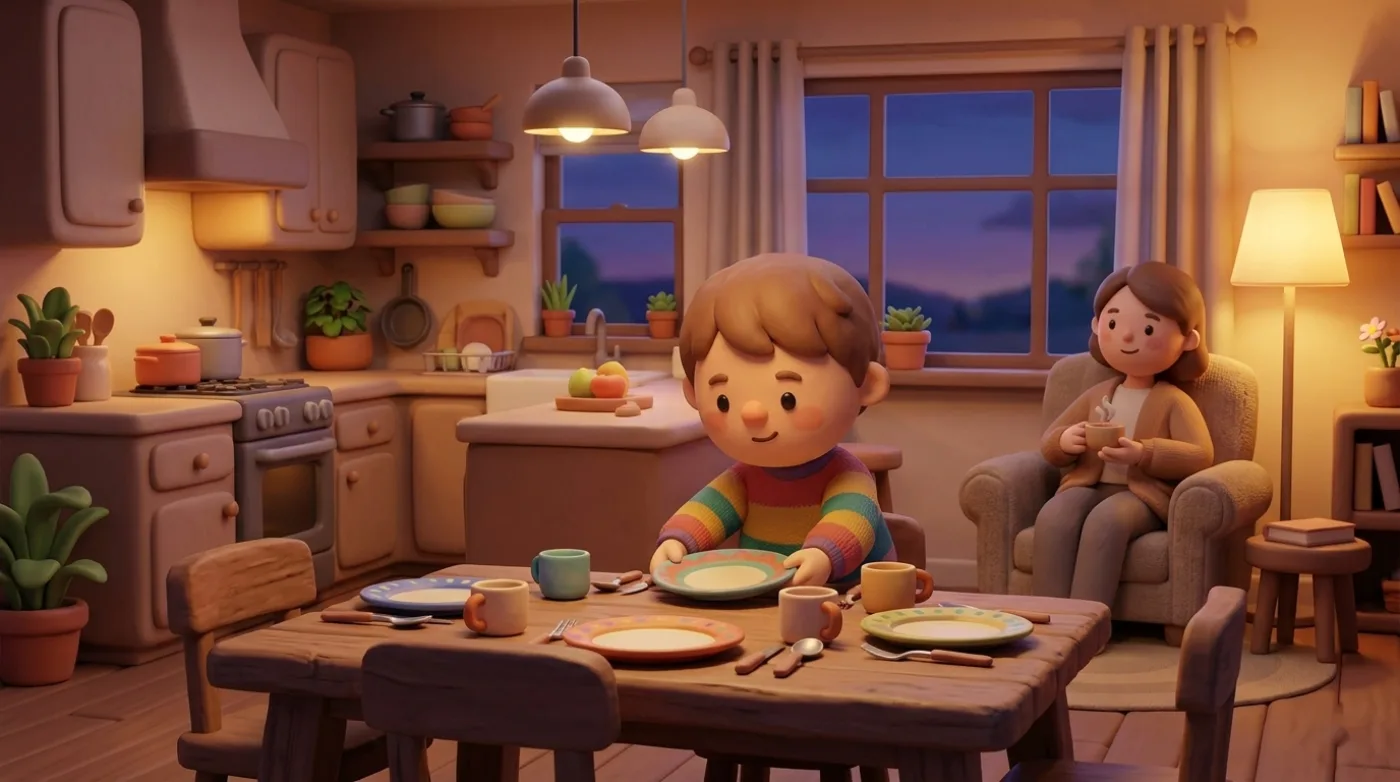
6:30 PM. The table is empty.
You asked your child to set the table twenty minutes ago. The table is empty. The child is on the floor building something with Legos. You asked again. Nothing. Third time, your voice went up. Fourth time, you did it yourself — because dinner is burning, and the argument would take longer than just doing it.
You slam the plates down a little harder than you meant to. The ceramic clicks against the counter. Your partner looks up. Nobody says anything.
The thing is: the Legos aren’t the problem. And you doing everything isn’t the solution. It’s the trap. The more you carry, the less anyone else picks up — not because they don’t care, but because the system is invisible. It lives in your head. Nobody else can see it.
You’ve tried everything. Here’s what’s actually happening.
You’ve tried asking. You’ve tried star charts. You’ve tried bribes. You’ve tried the calm explanation about “being part of a family.” And you’re still doing it yourself.
That’s not a failure of willpower. Yours or theirs.
I see it as a design problem. The chores live in your head. That means you’re the one who has to remember, initiate, follow up, and repeat. Every. Single. Time. And when nobody does the thing unless you ask, you’re not a parent — you’re a reminder service.
Here’s the shift: when chores are visible — on a board, in a routine, in an app — the system asks. Not you. And kids resist you asking far more than they resist a system.
Why starting young changes everything
Dr. Marty Rossmann at the University of Minnesota analyzed a longitudinal study following children into their mid-20s. She found that participating in household chores starting at ages 3-4 was the best predictor of success in young adulthood — measured by academic achievement, healthy relationships, and self-sufficiency — even after accounting for family background.1
Not reading to them. Not academic enrichment. Chores.
The catch: kids who didn’t start until 15-16 didn’t get the same benefit. The mechanism, as I read it, isn’t about the task. It’s about identity. A 3-year-old who “helps” — slowly, badly, with milk on the counter — learns: I am someone who contributes. That identity sticks.
How to make it work (without becoming the nag)
1. Start younger than feels useful
Morning. Your 6-year-old pours cereal. Milk splashes on the counter — some of it drips to the floor. You don’t fix it. She looks at the puddle, gets a cloth from the drawer, and wipes. Not perfectly. The counter is still damp. You leave it.
That damp counter is more valuable than a clean one you wiped yourself. Because she did it. Not because you asked — because she saw it.
A 3-year-old “helping” is slower than doing it yourself. That’s the point. You’re not building a housekeeper. You’re building a person who notices, acts, and owns the result.
2. Attach each chore to a fixed moment
Habits stick when a task owns a time slot. Toys before dinner. Backpack right after the afternoon snack. Dishes in the sink before screen time.
The fixed moment is what removes you from the equation. It’s not “mom said to do it.” It’s “this is when this happens.” The routine holds the structure — not your voice.
3. Make chores visible
A chart on the fridge. A whiteboard in the hallway. An app on the family tablet. The format doesn’t matter — what matters is that everyone can see what’s theirs without anyone having to ask.
When the task is visible, checking it off gives kids a small hit of ownership. And more importantly: you stop being the only one who knows what needs doing.
4. Offer choices, not orders
“Do you want to take out the trash or do the dishes?” lowers resistance far more than “go take out the trash.” Autonomy within a boundary beats a command.
A child who chose their chore owns it differently than a child who was told. The outcome is the same. The relationship to the task is not.
5. Let “good enough” be good enough
Re-doing a child’s crooked bed-making teaches them one thing: this isn’t really my job. If it were my job, my version would stand.
My advice: resist the urge to fix it. Competence grows from ownership, not correction. A badly folded towel that stays folded is how they learn. A perfectly re-folded towel is how they stop trying.
Chore-resistance decoder
When kids resist chores, the behavior usually means something specific. Matching the right response to the right signal saves everyone a fight.
| What they do | What it means | What works |
|---|---|---|
| Ignore you completely | Too absorbed — genuinely doesn’t hear | Physical proximity + eye contact first, then ask |
| ”In a minute!” (x5) | Transition is hard | Give a 2-min warning, then go together |
| Does it badly on purpose | Power struggle | Give a choice: “Trash or dishes?” |
| Melts down | Overwhelmed by the whole task | Break it smaller: “Just the forks" |
| "Why do I have to?!” | Fairness question | Show the family board: everyone has a row |
The decoder works both ways. If you find yourself raising your voice by the third ask — that’s a signal too. Not that you’re failing. That the system is asking too much of you and not enough of itself.
What happens when you stop asking
Laundry basket, full. Your teen says: “I have nothing to wear.” You say nothing. They look at the basket. They look at you. You’re reading something. They figure it out. The washing machine hums at 10 PM.
Nobody yelled. Nobody nagged. The natural consequence did the teaching — and it taught more in one evening than six months of reminders.
Natural consequences only work when the chore is visible and theirs. If they don’t know it’s their responsibility, the empty drawer is just confusing. But when the board says “laundry: Thursday” and it’s their name next to it — the empty drawer is a lesson that sticks.
The Saturday reset
Saturday morning. Three people cleaning. Music on. Nobody’s thrilled about it, but nobody’s fighting either. Because it’s Saturday — that’s when this happens. Not because someone asked. Because the routine holds.
One person does the bathroom. Another sweeps. The youngest carries the recycling — slowly, spilling a little. Nobody corrects. The podcast plays. It takes 40 minutes. Then it’s done for the week.
I don’t think that’s a dream scenario. That’s what happens when chores stop being requests and become structure. When everyone can see the board, when everyone has a row, when the expectation doesn’t change depending on who remembered to ask.
Start here
Tonight, pick one chore your child can do without instruction. Carrying their plate to the sink. Putting shoes on the rack. Dropping their clothes in the hamper.
Don’t ask them to do it. Just wait. See what happens when the old routine holds without your voice in it.
Tomorrow, if it didn’t happen — don’t nag. Put it on the board. Make it visible. Let the system ask.
Why this is actually a systems problem
I don’t believe kids resist chores because they’re lazy. They resist because the expectations are invisible — different every day, inconsistent between parents, and dependent on whoever remembers to ask.
Chores work when they’re not requests. When they’re just… visible. Part of the day. Written down somewhere everyone can see.
The exhaustion of chores was never about the work. It was about holding who does what and when in one person’s head — and that person is usually the same one. Every time.
ParentOS, the family organization app I’m building to reduce the mental load of parenting, makes chores visible to the whole family in one place: everyone sees what’s theirs, kids check off tasks and earn stars, and you stop being the one who remembers. Shared awareness instead of nagging.
ParentOS is built privacy first — no ads, and your data is not sold. If you’re looking for a calmer way to organize family life — join the early access.
Frequently asked questions
At what age should kids start doing chores? As early as ages 2-3. A University of Minnesota longitudinal study found that participating in chores starting at ages 3-4 was the strongest childhood predictor of success in young adulthood — stronger than academic performance or family background.1
How do I get my child to do chores without nagging? Make chores visible and consistent. Put them on a board or in an app so the system reminds — not you. Attach each chore to a fixed moment in the day, offer choices instead of orders, and stop being the human reminder service.
Should I pay kids for chores? Most experts recommend treating basic household chores as a family contribution — everyone lives here, everyone helps. An allowance or points system can work as a supplement, but paying per chore risks making contribution conditional on reward. (See the guide to allowance by age.)
What if my child does the chore badly? Leave it. A crooked bed that your child made is more valuable than a perfect bed you re-did. Re-doing their work teaches them it was never really their responsibility. Competence grows from ownership, not correction.
Sources
Related articles
Calm families start with shared awareness.
Footnotes
-
Rossmann, M. (University of Minnesota) — longitudinal analysis linking early childhood chores (ages 3-4) to success in young adulthood. Summary: Psychology Today, “Best Age for Kids to Start Doing Chores”. ↩ ↩2