
Family Vacation Packing List (By Category): The Calm Checklist
TL;DR: The packing list that actually works is organized by category — documents, clothes, toiletries, kids’ essentials, tech, and a small first-aid kit — so you can check each section off without circling the house. Below is a copy-paste checklist, a carry-on survival kit for when luggage goes missing, and the one upgrade that removes most travel-morning stress: making it a shared list the whole family packs from, not a single person’s mental inventory.
11:17 PM, the night before the flight
The suitcase is open on the bed. You’ve packed. You’ve unpacked. You’ve repacked. You’ve put the passports in the front pocket, then moved them to your bag, then moved them back because what if that bag goes in the hold?
The kids are asleep. Your partner is asleep. And you’re lying in the dark running the loop: chargers, swimsuits, that stuffed bunny she can’t sleep without, the prescription drops that are in the medicine cabinet or maybe the bathroom drawer or maybe —
You get up. Cold tiles on bare feet. You check. They’re there. You go back to bed. The phone screen says 11:43 now. The loop restarts.
This isn’t a packing problem. It’s a memory problem. Psychologists call it prospective memory — remembering to do something in the future — and research shows it’s one of the most failure-prone parts of human cognition. External cues (a visible list, a notification) reliably outperform trying to hold intentions in your head1. The entire family inventory lives in your head, and your head won’t stop auditing it because there’s nowhere else to check.
In my view, a good packing list doesn’t solve this by adding more items. It solves it by getting the inventory out of your head and onto something you can see — so you can look at it, confirm it’s handled, and close your eyes.
Pack by category, not by panic
The trick is grouping. Surgeon and researcher Atul Gawande showed that even highly trained professionals miss critical steps under pressure — until they use a checklist. A 19-item surgical checklist tested across eight hospitals cut complications by 36%2. Packing a suitcase isn’t surgery, but the cognitive mechanism is the same: when the list is one long scroll of forty items, you lose your place and miss things. When it’s grouped by category — documents, clothes, toiletries, kids, tech, health — you check off whole sections with confidence.
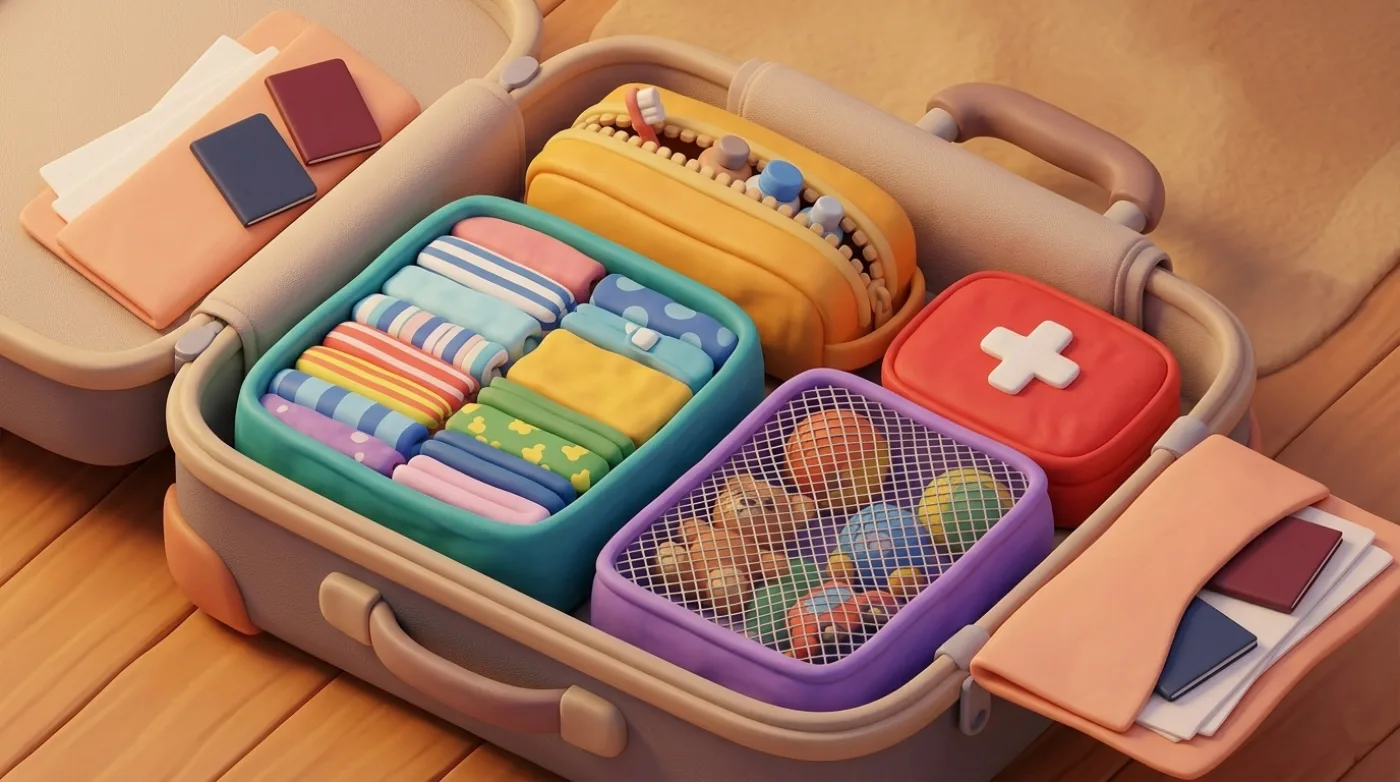
Each category catches a different kind of forgetting. Documents catch the “we’re at the airport and the passports are on the kitchen table.” Kids’ essentials catch the comfort item that seems trivial until midnight in a hotel room without it. Health catches the prescription you remember at 35,000 feet.
Here’s my starting checklist. Trim and add for your trip, climate, and kids’ ages.
DOCUMENTS & MONEY
[ ] Passports / IDs
[ ] Tickets / boarding passes
[ ] Travel insurance details
[ ] Wallet, cards, some cash
[ ] Accommodation confirmation

CLOTHES (per person)
[ ] Tops + bottoms (1 per day +1)
[ ] Underwear + socks
[ ] Pajamas
[ ] Jacket / layer
[ ] Swimwear
[ ] Comfortable shoes + one spare pair
[ ] Hat / sunglasses

TOILETRIES
[ ] Toothbrushes + toothpaste
[ ] Shampoo / soap
[ ] Sunscreen
[ ] Deodorant
[ ] Hairbrush / hair ties

KIDS' ESSENTIALS
[ ] Comfort item (the non-negotiable one)
[ ] Snacks for travel
[ ] Wipes
[ ] Activities / small toys / a book
[ ] Spare clothes in carry-on (for spills)
[ ] Diapers / pull-ups (if needed)

TECH
[ ] Phone + chargers
[ ] Power bank
[ ] Headphones
[ ] Travel adapter
[ ] Tablet + offline downloads for the journey

HEALTH & SAFETY
[ ] Any prescription medications
[ ] Mini first-aid kit (plasters, pain relief, thermometer)
[ ] Hand sanitizer
[ ] Insect repellent
The carry-on rule
The airport carousel. Your suitcase isn’t there. You watch the same three bags circle past — a battered red Samsonite, a black duffel with a neon strap, someone’s box wrapped in plastic film. The belt keeps turning. Your bag keeps not appearing. Your four-year-old needs her inhaler. It’s in the suitcase. She needs a change of clothes — the juice spill from the flight is drying stiff on her leggings. Also in the suitcase. And her bear. The bear she cannot sleep without. In the suitcase.
That’s why I treat the carry-on as the real list.
It’s not a rare scenario either. Airlines mishandled 33.4 million bags in 2024, with transfer connections accounting for 41% of cases. International flights are five times more likely to lose luggage than domestic ones3.
Whatever you do, keep the “if the luggage gets lost” survival kit in the carry-on. Here are the eight items that turn a lost-luggage disaster into a manageable inconvenience:
- Prescription medications — pharmacies abroad may not carry them, and you can’t wait two days for a rerouted bag.
- One change of clothes per child — spills, accidents, and the “I’m wearing this wet swimsuit” meltdown.
- One change of clothes per adult — you’ll feel human enough to handle the rest.
- The comfort item — whatever your child cannot sleep without. This is non-negotiable luggage.
- Snacks — hunger makes every delay worse, for everyone.
- Travel documents — passports, boarding passes, insurance details, accommodation confirmation.
- Phone charger and power bank — you’ll need your phone to file the lost-luggage claim, navigate to the hotel, and keep the kids occupied.
- Wipes — the universal parenting tool. Hands, faces, seats, sticky situations literal and figurative.
Everything else is replaceable. These eight items are the difference between “our bag is delayed, we’ll manage” and a genuine crisis.
Pack as a shared list
Loading the car. You’re doing the Tetris — rotating the big suitcase, wedging the stroller bag against the wheel well, stacking the cooler bag on top and hoping the eggs in the grocery bag underneath survive. Your partner stands in the doorway holding a pillow: “Should I bring the —”
“It’s IN there!” you snap.
You don’t mean to. You’re just holding forty-seven items in your head and he asked about item forty-eight. The sharpness in your voice surprises both of you. The kids go quiet in the backseat.
This is the invisible cost of being the only person who holds the full packing inventory. It’s not the physical work — it’s the cognitive load of tracking every item for every person, fielding questions about things you’ve already handled, and carrying the anxiety that something’s missing because there’s no way to prove it isn’t.
Here’s the upgrade most families never make: the packing list lives in one parent’s head, so that parent becomes mission control — packing for everyone, fielding “where’s my charger?”, and quietly carrying the stress. It doesn’t have to work that way.
When the list is shared — visible to both adults and to kids old enough to read — packing becomes a team sport:
- Each person can take their own section and check it off.
- A second adult can pack the toiletries without asking what goes in.
- Kids can be handed their own short list (“your bag: pajamas, swimsuit, book, the bear”) and pack it themselves — which, bonus, teaches them a life skill.
- Nobody has to keep the whole inventory in their head, so the night-before loop quiets down.
To me, that shift — from one packer to a shared checklist — is the difference between a frazzled departure and a calm one.
The return trip
Here’s how you know the system works: the return trip.
Packing takes twenty minutes. Everyone packs their own section. The eight-year-old checks off his list: “Pajamas, swimsuit, book, charger, the rock I found.” He zips his bag. Done.
The four-year-old needs help, but she knows what’s hers. She puts the bear in first — priorities — and then the swimsuit, and then she looks at you: “Wipes?” You nod. She puts them in.
Your partner packs the toiletries without asking. You pack the documents. Nobody snaps. Nobody does Tetris alone in the driveway while someone stands in the doorway holding a pillow.
Twenty minutes. That’s the return trip when the list is shared.
Start here
You don’t have to systematize every trip tonight.
For the next trip, I suggest one thing: make one shared checklist both adults can see. Check things off as they go in the bag. That alone kills the night-before loop — because you can see what’s packed instead of remembering it.
The packing anxiety isn’t about packing. It’s about being the only person who holds the full inventory. When the list is shared and visible, packing becomes a team sport — and the night-before loop quiets down.
Quiet house. The suitcases are by the front door, zipped. The checklist shows every section green. You’re in bed, and for once you’re not running the loop — because you already checked. It’s all there. You can see it.
Your partner packed half of it. Your kid packed his own bag. And you can close your eyes.
Pause
That’s what shared awareness feels like. Not doing less — seeing that it’s done, together. I’m building ParentOS, a family organization app, around that idea: shared checklists, family calendar, and trip planning in one place — so no single parent carries the whole inventory alone.
If that sounds useful — see how it works.
ParentOS is an adaptive family operating system where your family’s data stays yours — privacy first, no ads, no selling your data. If you’re looking for a calmer way to organize family life — join the early access.
Sources
Frequently asked questions
What should a family vacation packing list include? Group it by category: documents and money, clothes per person, toiletries, kids’ essentials (comfort item, snacks, wipes, activities), tech (chargers, power bank, adapters), and a small health and safety kit with any medications and first aid.
How do I pack for kids without forgetting things? Give each child their own short list and let them pack it — pajamas, swimsuit, a book, the comfort item — and always keep a change of clothes plus wipes in the carry-on for spills. A category checklist means you check off whole sections instead of circling the house.
What should always go in the carry-on? Your “if the luggage is lost” survival kit: prescription medications, one change of clothes per person, the kids’ comfort item, snacks, and all travel documents. Everything else is replaceable.
How do we share packing so it’s not all on one parent? Make the packing list shared and visible so each person can take their own section. A second adult packs without asking what goes in, kids pack their own bags, and nobody has to hold the full inventory in their head.
Related articles
Calm families start with shared awareness.
Footnotes
-
McDaniel, M.A. & Einstein, G.O. Prospective Memory: An Overview and Synthesis of an Emerging Field. Sage Publications, 2007. Foundational review showing that external cues outperform unaided memory for future-oriented tasks, with event-based external reminders improving completion rates two- to fourfold. source ↩
-
Haynes, A.B., Weiser, T.G., Berry, W.R. et al. A Surgical Safety Checklist to Reduce Morbidity and Mortality in a Global Population. New England Journal of Medicine, 2009; 360:491–499. A 19-item checklist tested in eight hospitals worldwide cut surgical complications by 36% and deaths by 47%. source ↩
-
SITA. Baggage IT Insights 2025. SITA, 2025. Airlines mishandled 33.4 million bags in 2024 (6.3 per 1,000 passengers). Transfer connections caused 41% of cases; international routes are five times riskier than domestic. source ↩