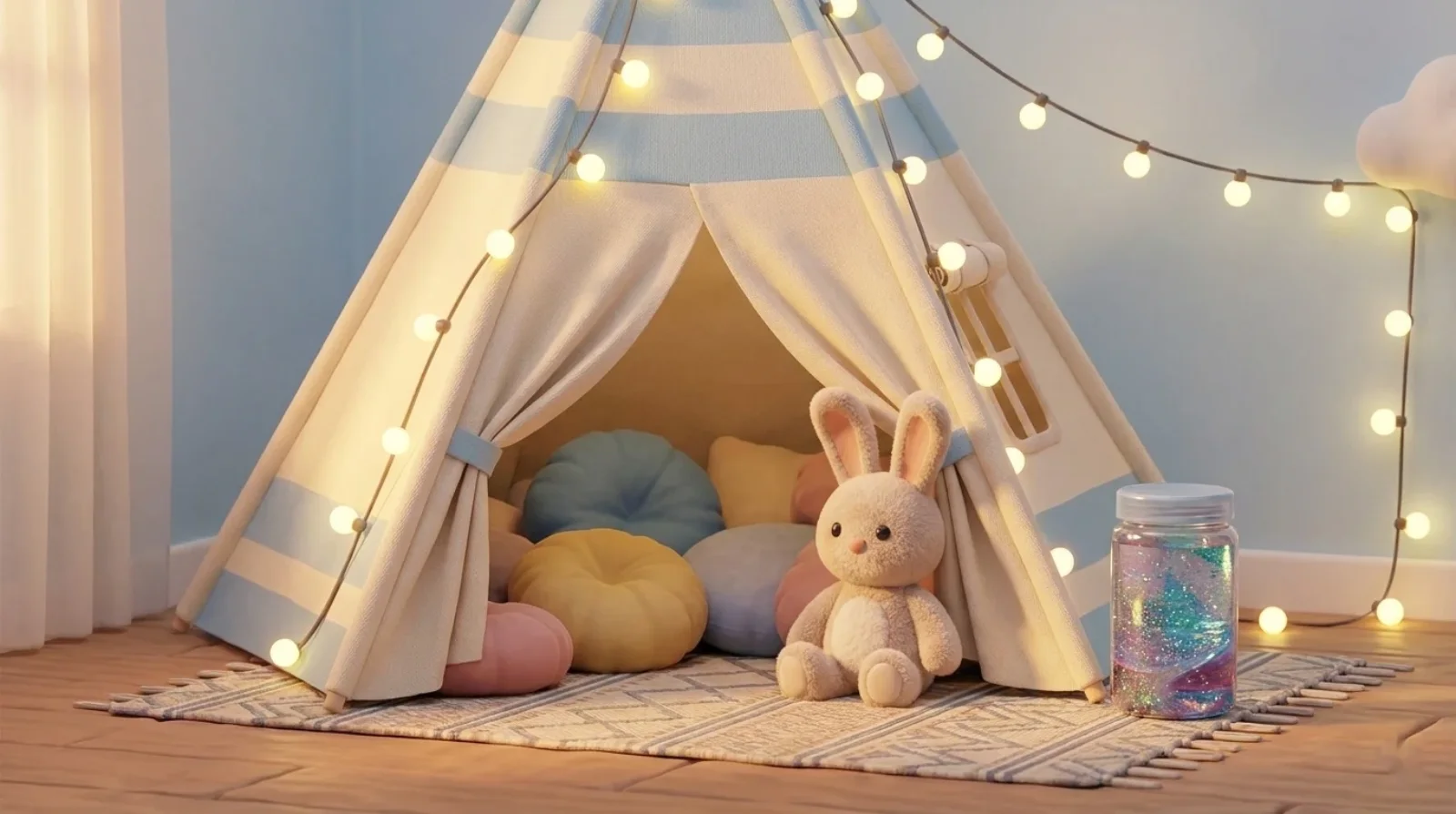
Calm Down Corner Ideas: How to Build One That Actually Helps
TL;DR: A calm down corner is a small, cozy space where a child can go to regulate big emotions — not a punishment, not a reward, just a place where big feelings go to be felt. Start with a cushion and one comfort object in a quiet spot. The two rules that make or break it: introduce it when everyone is calm, and never use it as a time-out. Every caregiver in the house needs to know the same rule — this is a place to feel better, not to “think about what you did.”
The thrown toy
Your four-year-old just threw a toy car at his sister’s head. She’s crying. He’s crying. You’re standing in the doorway with wet hands from the sink, dish soap still on your fingers. In your head, three scripts are fighting: “Go to your room!”, “Use your words!”, and the gentle parenting voice that says “validate his feelings.”
But right now — right this second — you need a PLACE. A physical spot where the storm can land without casualties. Not a punishment. Not a reward. Just a spot where big feelings go to be felt, not fixed.
That’s what I mean by a calm down corner. Not a strategy you recite. A place your child’s body already knows.
Why a place, not a strategy
Here’s the thing nobody tells you in the parenting books: a child mid-meltdown cannot “use their words.” Not because they’re being difficult. Because the prefrontal cortex — the part of the brain responsible for language, reasoning, and impulse control — goes offline when the emotional brain floods.1 It’s neurology, not defiance.
Telling a dysregulated child to “take a deep breath and tell me what you feel” is like asking someone to write a sonnet while their house is on fire. The thinking brain isn’t there yet.
What IS available during a meltdown: the body. Touch. Pressure. Texture. Containment. A child who can’t form the sentence “I’m angry because she took my toy” CAN squeeze a stress ball, press their face into a cushion, or curl up under a weighted blanket. The calm down corner gives the body what it needs — sensory input, safety, physical space — while the brain catches up.
The way I see it, regulation is embodied, not intellectual. The corner works because it meets the child where they actually are, not where we wish they were.
What to put in it
She’s sitting on the beanbag, squeezing the stress ball rhythmically. You can hear the faint crinkle of the filling inside. Her breathing is slowing — you can see her shoulders dropping, one centimeter at a time. After two minutes, she looks up. “I was really mad,” she says. Not because you asked. Because the body got there first, and the words followed.
That’s what the right items do. Not entertain. Not distract. They give small hands something to DO while big feelings run their course.
Start here (today)
- A cushion or beanbag — something soft to sit on, sink into.
- One comfort object — a blanket, stuffed animal, or pillow. Whatever your child would grab during a thunderstorm.
- A quiet spot — away from the kitchen action, the TV, the sibling who’s still crying. It doesn’t need to be a whole room. A corner behind the couch works.
That’s the whole setup. Three things. You can stop here and it will work.
Add when ready
- A breathing poster — simple visual: breathe in for 4, hold for 4, breathe out for 4. Tape it to the wall at child height.
- A feelings chart — faces with emotion names so a child can point to what they feel before they can name it.
- A stress ball or fidget — something to squeeze. The rhythmic pressure calms the nervous system.
- Two or three calming books — quiet favorites, not exciting adventures. The kind of book that makes your own breathing slow down.
You don’t need all of it. I’d take two or three items your child actually reaches for over a Pinterest-perfect sensory station they walk past.
How to introduce it

Calm Saturday morning. Nobody is upset. Nobody is in trouble. You and your child are sitting on the floor together, arranging the cushion, choosing which books go on the little shelf, taping the breathing poster to the wall at exactly the right height. Your child picks the stuffed animal — the gray elephant, obviously, the one with the chewed ear.
“This is your spot for big feelings,” you say. “When everything gets really loud inside, you can come here. Let’s try it now.”
You sit in it together. You squeeze the stress ball. You both breathe in for four and out for four, and your child laughs because you’re making exaggerated whooshing sounds. It’s a project. A Saturday morning thing. Not a punishment announcement.
This is the part I think matters most: the corner must be introduced during peace, not during war. A tool shown to a child mid-meltdown — while they’re flooded, while the prefrontal cortex is offline — just feels like banishment. Another version of “go to your room.” The child files it under “punishment” and will resist it every time.
But a corner they helped build? A corner they chose the cushion for? That’s theirs.
The five steps that make it work
- Set up the basics. Cushion, one soft thing, quiet spot. Done.
- Introduce during calm. Saturday morning, not Wednesday meltdown.
- Offer, never sentence. “Would the calm corner help right now?” is an invitation. “Go to your corner” is a command. The child hears the difference instantly.
- Co-regulate first. Younger kids need you WITH them — sitting beside them, breathing slowly, modeling calm. Research shows children develop self-regulation partly by internalizing the calming strategies their caregivers model during co-regulation.2 You’re not fixing them. You’re being the calm they can borrow until they grow their own.
- Welcome them back warmly. No lecture. No “now are you ready to say sorry?” The goal was to feel better, and they did. The conversation about the thrown toy can happen later, when the prefrontal cortex is back online.
The one mistake that ruins it
Don’t let the calm down corner become a time-out.
If I had to name one failure to watch for, it’s this one. And it happens gradually — not because parents are doing something wrong, but because “go calm down” is so close to “go to your room” that the line blurs without anyone noticing.
The moment “go to the calm corner” means “you’re in trouble,” it stops being a regulation tool and becomes a punishment your child will fight. The body learns: this place means I did something bad. And a place associated with shame cannot also be a place of safety. Those two things cannot coexist.
The rule is simple: the child chooses to go. Always. An adult can offer (“Would the calm corner help?”), but never order. If the child says no, that’s okay. The corner will be there next time.
The calm corner setup card
Print this or screenshot it. Put it on the fridge. Both parents read it.
Essential (today):
- A cushion or beanbag
- One comfort object (blanket, stuffed animal)
- Quiet spot away from the action
Add when ready:
- Breathing poster (breathe in 4, hold 4, out 4)
- Feelings chart (faces with emotion names)
- Stress ball or fidget
- 2–3 calming books
Rules to agree on (both parents!):
- Child chooses to go (never forced)
- Not a punishment — never say “go to your corner”
- Adult can join if child wants company
- No time limit — child decides when they’re ready
When it starts working
Tuesday evening. Something goes wrong — the block tower fell, the sibling said something, the world ended for the forty-seventh time today. You brace yourself. You feel your own shoulders tighten.
But your child stands up. Walks to the corner. Sits down on the beanbag. Grabs the gray elephant with the chewed ear. You didn’t say anything. The corner said it for you.
This is what self-regulation looks like when it’s not a script — when it’s a place. The child’s body knows what to do because the body learned it on a calm Saturday morning, not during a crisis.
You stand in the kitchen doorway. Your hands are dry this time. And for thirty seconds, nobody is crying.
Calm corners work better when the day is calmer
A calm down corner helps a child ride out a storm. But fewer storms start when the day itself is predictable. Much of what tips kids — and parents — over the edge is invisible chaos: the forgotten lunch, the surprise schedule change, the evening scramble because nobody checked what was happening after school.
A calm down corner works because it makes the invisible visible: there IS a place for feelings, and it’s ALWAYS there. But it works best when every adult in the house knows it exists, knows the rules, and responds the same way. Consistency isn’t about perfection — it’s about everyone seeing the same approach.
That’s the thinking behind ParentOS, the family organization app I’m building to reduce the mental load of parenting: when your family’s rhythm — meals, routines, who’s where — is visible and shared, there’s less friction to regulate in the first place.
And if today isn’t the day — that’s okay. Come back to this when you’re ready. The corner will be there.
ParentOS is a family organization app built privacy first — no ads, and your data is never sold. If you’re looking for a calmer way to organize family life — join the early access.
Frequently asked questions
What should be in a calm down corner? Start with the essentials: a cushion or beanbag, one comfort object (blanket, stuffed animal), and a quiet spot away from the action. Add a breathing poster, feelings chart, stress ball, or calming books when ready. Keep it small and uncluttered — two items your child actually reaches for beat a Pinterest-perfect setup they ignore.
Is a calm down corner the same as a time-out? No — and that distinction is the difference between a tool that works and one your child resists. A time-out is a consequence imposed by an adult. A calm down corner is a choice the child makes. The moment you say “go to your corner,” it stops being regulation and becomes punishment.
At what age can a child use a calm down corner? From the toddler years onward, though younger children usually need an adult to co-regulate with them first. A two-year-old might sit in the corner with you. A five-year-old might walk there alone. Both are success.
How do I introduce a calm down corner? On a calm Saturday morning, not mid-meltdown. Set it up together — let your child choose the cushion, pick the books, tape the breathing poster to the wall. Practice sitting in it when nobody is upset. A tool introduced during a storm just feels like banishment.
Sources
Related articles
Calm families start with shared awareness.
Footnotes
-
Siegel, D. J., & Bryson, T. P. (2012). The Whole-Brain Child: 12 Revolutionary Strategies to Nurture Your Child’s Developing Mind. Bantam. The “flipping your lid” model describes how the prefrontal cortex goes offline during emotional flooding. ↩
-
Eisenberg, N., & Spinrad, T. L. (2004). Emotion-Related Self-Regulation in Children. Zero to Three, 24(5). Summary and review: PMC / NIH. ↩