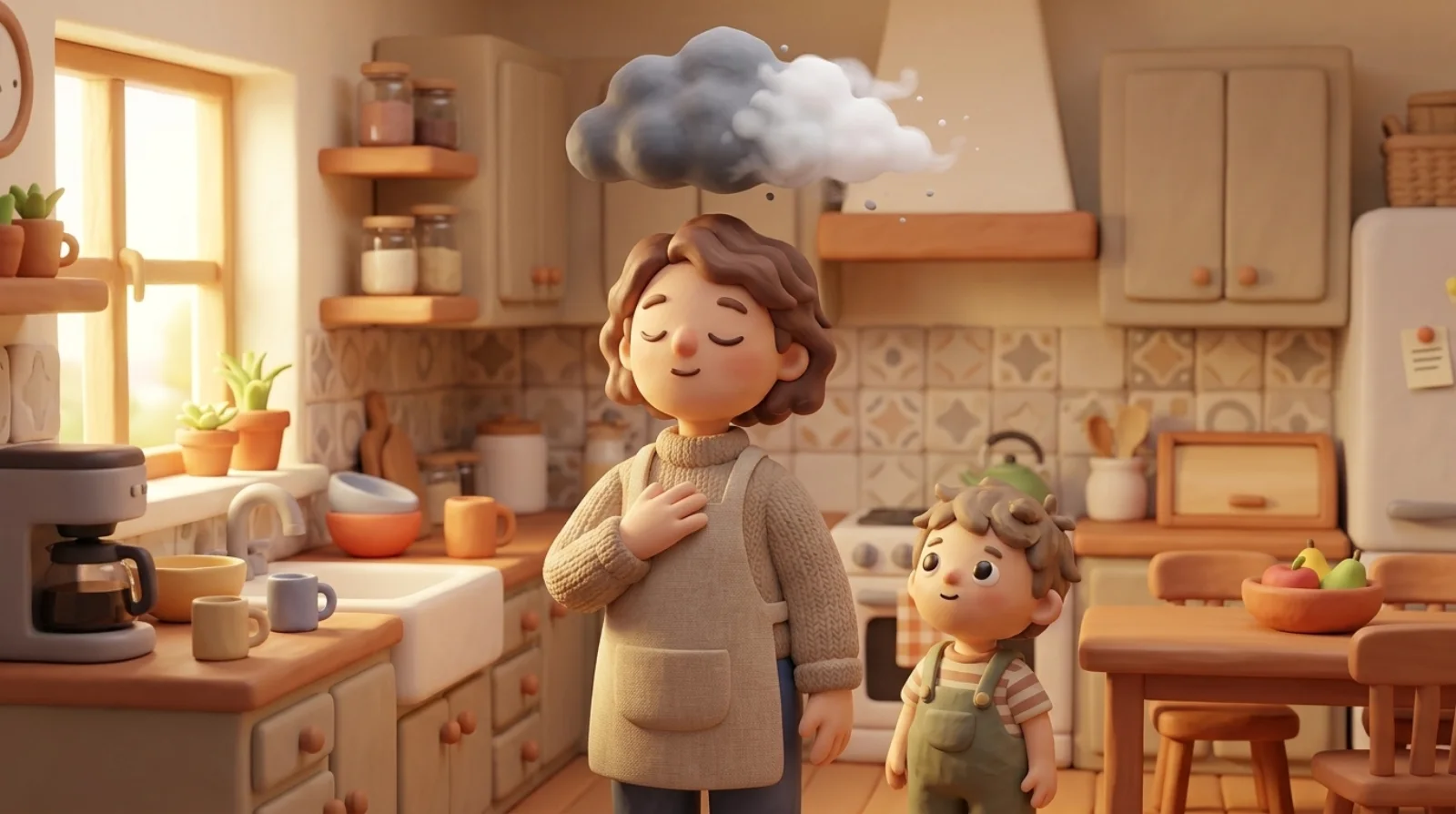
How to Stop Yelling at Your Kids: 7 Strategies That Work
TL;DR: Yelling isn’t a character flaw — it’s a body signal that you’ve hit capacity. Start from your own body (jaw, shoulders, breath), build a calmer daily rhythm, and replace shouting with concrete scripts. Research shows harsh verbal discipline harms children in ways comparable to physical punishment — but every parent can learn to catch the yell before it lands.
6:15 PM. Pasta boiling over on the stove, steam curling toward the ceiling. Your younger child is crying because they bumped the table — milk pooling across the placemat. From the bathroom, the older one screams “MOM!” for the third time.
And then it happens. The yell escapes before you can catch it. A sharp, loud thing you didn’t plan.
Silence.
You see your child’s face go still. You feel the heat behind your ears, spreading down your neck. Your hands are trembling on the cold edge of the countertop.
That moment — the silence after the yell — is where this article begins. Not with a lecture. Not with a definition of “harsh verbal discipline.” With your body, your kitchen, your Tuesday evening. Because I don’t think yelling makes you a bad parent. It makes you an overloaded one. And those are two very different things.
What yelling actually does — and why warmth doesn’t fix it
A landmark longitudinal study by Ming-Te Wang and Sarah Kenny, published in the peer-reviewed journal Child Development, followed 976 two-parent families and their adolescents. They tracked what happens when parents yell, curse, or use insults regularly. The findings were stark: adolescents who experienced it showed more depressive symptoms and more behavior problems — and the negative effect was comparable to what other studies found for physical discipline.1
Here’s the part I find stings most: parental warmth did not offset the harm. The everyday love and support a parent shows — the bedtime stories, the I-love-yous — didn’t protect a child from the damage of being shouted at. The sense that “I yell, but they know I love them” turns out to be a story we tell ourselves, not a shield for the child.
Yelling also fails on its own terms. It might stop a behavior in the moment, but it doesn’t teach the lesson you actually want your child to learn. It teaches them to freeze — or, eventually, to stop listening altogether.
Pause
If you’re reading this at 11 PM and you already yelled today — put this article down. You don’t need to fix anything tonight. Looking for answers is already a step, and the answers will still be here tomorrow.
7 strategies to stop yelling — starting from your body
1. Manage yourself first
Feel your jaw. Right now. Is it clenched? If you’re reading an article about yelling, there’s a good chance it is. Unclench it. Drop your shoulders an inch. That took two seconds, and it changed the tension in your whole upper body.
That’s the practice. Before anything else, regulate your own body — not your child’s behavior. If you feel an outburst rising and your child is in a safe place, step out of the room. Three breaths with a slow exhale. Splash cold water on your wrists.2 I don’t see that as running away. That’s modeling exactly what you want to teach: big emotions can be handled without shouting.
2. Prevent fires instead of putting them out
Many blow-ups are predictable — you just don’t see the pattern until you look. Hunger, tiredness, overstimulation, transitions between activities. A steady daily rhythm, regular meals, and enough sleep cut the number of flashpoints dramatically.2
The more predictable the day, the fewer moments where everything ignites at once.
3. Name what’s happening — in you, then in them
“I’m tired and I’m about to lose it.”
Say it out loud. That sentence is a circuit breaker. It’s honest, it’s fast, and it does something remarkable: it moves you from reacting to narrating. Once you’ve named your own state, you can name theirs: “I can see you’re really angry that screen time is over.” Naming emotions lowers the temperature for both of you.
4. Get down to their level and whisper
Notice the room shift when you drop to their eye level and lower your voice to almost nothing.
Counterintuitively, quieter lands harder. Kneel down, make eye contact, speak at the volume of a secret. A child has to settle to listen — and they settle faster when you’re the calm one. A whisper says: I’m not scared. I’m here. I’m in control. A yell says the opposite.
5. Hold boundaries without raising your voice
Calm doesn’t mean permissive. “Toys first, then a story,” said once, calmly and consistently, works better than ten escalating repetitions. Children need clear, predictable boundaries — not loud ones.
The trick is saying it once, then waiting. Silence after a boundary is more powerful than repetition.
6. Catch them being good
Pay attention to what your child does right — not only what they do wrong. “Catch” them behaving well and acknowledge it: “You put your shoes on without me asking — I noticed.”3 When children get attention for positive behavior, they have less reason to seek it through the difficult kind.
7. Repair after a hard moment
You will raise your voice. Every parent does. What matters, I believe, is what happens next.
Return to your child once things have calmed. A short, honest repair — “I’m sorry I shouted. I was tired, and that wasn’t the right way to talk to you” — teaches something more valuable than the original lesson ever could: that mistakes don’t break things permanently. They can be mended. And that builds the relationship rather than eroding it.
Instead-of-yelling scripts: 5 situations

Knowing what to say instead is half the battle. I put them in a table you can screenshot and keep on your phone for the hard moments:
| Situation | Instead of yelling | Say this |
|---|---|---|
| Child ignores you (4th time) | “HOW MANY TIMES?!" | "I see it’s hard to do this right now. Need help or a minute?” |
| Messy room | ”CLEAN IT NOW!" | "Room needs tidying. Start with toys or clothes?” |
| Siblings fighting | ”STOP IT!" | "Stop. Both sit down. What happened?” |
| Morning rush | ”HURRY UP!" | "5 minutes left. What still needs doing?” |
| Food refusal | ”EAT IT OR ELSE!" | "You don’t have to eat it. Dinner’s here until 6:30.” |
Notice the pattern: every replacement gives the child a choice or information instead of a command. Choices lower resistance. Information makes the situation feel manageable.
Start here — tonight
If everything above feels like too much, I suggest taking one thing:
Tonight, when you feel the tension building in your jaw — unclench it. Count to five. That’s all. The scripts, the strategies, the repair conversations — those will come. Start with your jaw.
Where yelling actually comes from
Most parenting advice treats yelling as a discipline problem — something you do to your child. But I think yelling is rarely about the child. It’s a body signal that you are at capacity.
Think about the last time you yelled. Was it really about the shoes on the floor? Or was it the accumulated weight of everything held in your head — dinner, the unsigned permission slip, tomorrow’s schedule, the dentist appointment you keep forgetting to book, the text from school you haven’t replied to?
Every unresolved task sits in your working memory like an open browser tab. By 6 PM, you’re running forty tabs. And then your child asks for a snack in a whiny voice, and the browser crashes.
You yell more when everything lives in your head. Every extra “MOM!” is the drop that overflows the cup. The yelling isn’t the problem. The invisible weight is.
What if some of that logistics didn’t have to live in your head?
A calm home starts with shared weight
This is the idea I’m building ParentOS on — not a parenting course, not a meditation app, but a family operating system built around one principle: shared awareness over individual memory. A shared calendar, routines, and responsibilities visible to the whole family, so no one person carries the full picture alone.
Less invisible weight means fewer moments where a small trigger produces a big reaction. Less “I told you three times” because the information is already visible. Fewer overflows, because the cup isn’t as full.
Shared awareness — one glance at your family’s whole day, without holding it all in your head. If that resonates, join the early access.
Frequently asked questions
Is yelling at kids harmful? Yes. Longitudinal research shows harsh verbal discipline (yelling, insults, put-downs) is linked to higher rates of depressive symptoms and behavior problems in children, with effects that can be comparable to physical punishment.1
Does occasional yelling make me a bad parent? No. Every parent raises their voice sometimes. What matters is whether yelling is the exception or the main method — and whether you repair the relationship afterward.
How do I calm down fast when my child pushes my buttons? Pause before reacting, take a few deep breaths, and if your child is safe, step away briefly to settle. Then respond in a calm voice.2
Does calm parenting mean no boundaries? No. You can set clear, consistent boundaries without yelling. A calm tone and predictable rules work better than a raised voice.
Sources
Related articles
Calm families start with shared awareness.
Footnotes
-
Wang M.-T., Kenny S. (2014). Longitudinal Links Between Fathers’ and Mothers’ Harsh Verbal Discipline and Adolescents’ Conduct Problems and Depressive Symptoms. Child Development, 85(3), 908–923. doi:10.1111/cdev.12143 · PubMed 24001259 · study summary, EurekAlert / University of Pittsburgh — longitudinal study of 976 two-parent families; harsh verbal discipline at age 13 predicted increased conduct problems and depressive symptoms at age 14; parental warmth did not offset the harm. ↩ ↩2
-
Mayo Clinic — Temper tantrums in toddlers: How to keep the peace. mayoclinic.org ↩ ↩2 ↩3
-
American Academy of Pediatrics (HealthyChildren.org) — Positive Reinforcement Through Rewards. healthychildren.org ↩