Teaching Kids About Money: The Checkout Line Is the Classroom
TL;DR: You don’t teach kids about money in one big talk — you teach it in dozens of small, ordinary moments where money actually changes hands. The skills build in order: little kids learn that coins disappear when you buy things; school-age kids learn to save toward a goal and feel the gap when the jar is short; teens learn to hold a ticket they paid for themselves and feel its weight. Match the lesson to the stage, let them make small mistakes while the stakes are low, and the habits set early. Age-by-age table and real-life scenarios below.
You’re at the checkout
Your seven-year-old is holding a toy she found in aisle three — a plastic unicorn, $4.99. “Can I have it?” The line is moving. People behind you. You can feel their eyes, or maybe you’re imagining it. The scanner beeps. Someone’s toddler is crying two lanes over.
You could say yes and move on. You could say no and brace for the meltdown.
But here’s the thing nobody teaches you: this moment — right here, with the toy and the line and the eyes — IS the money lesson. Not a lecture about saving. Not a budgeting app for kids. Not a Sunday morning talk at the kitchen table.
This. A small, real decision with her own money or yours, made in a place where money actually changes hands.
She looks up. The unicorn’s mane is tangled. Your wallet is in your back pocket and your keys are digging into your thigh through the fabric. The person behind you shifts their weight.
“Is it your money or mine?” you ask.
And something shifts in her face. She’s thinking. Actually thinking — not performing, not reciting a rule. Thinking about what it means for a thing to cost something.
That’s where financial literacy begins. Not in a classroom. In a checkout line, holding a plastic unicorn.
Here’s the part I find reassuring: research from the University of Cambridge, published by the UK’s Money Advice Service, found that children’s core money habits — including the ability to plan ahead and delay gratification — are largely formed by around age seven.1 That sounds like pressure, but read it the other way: the everyday moments you’re already living are the lessons. You don’t need a curriculum. You need to match what you say to what they can actually understand.
Why real transactions teach more than lectures
Money lessons don’t stick as explanations. They stick as lived experience — the disappointment of a piggy bank that’s still short, the small pride of buying something with your own coins, the surprise that the “magic card” is actually Mum and Dad’s wages. A systematic review of financial-education programs confirms this: the most promising method for teaching children and adolescents is “experiential learning” — hands-on encounters with real money — while classroom-only programs improve knowledge but show little effect on actual financial behavior.2
The Cambridge research is clear: the “habits of mind” behind financial decisions form in the first few years of life.1 So the goal at every age isn’t a perfect understanding of finance — it’s a steady drip of real choices, sized to what the child can grasp right now.
The reason money lessons don’t stick from lectures is that money is abstract until it’s YOURS. As I see it, the job of a parent isn’t to teach economics — it’s to create situations where a child holds money, makes a choice, and lives with the result.
Age-by-age: what to focus on (and what it actually looks like)
Each stage builds on the one before. My advice: don’t rush ahead — a four-year-old can’t budget, and a teen who never learned to wait will struggle to.
| Age stage | What they can grasp | What to teach | Try this | What this looks like in real life |
|---|---|---|---|---|
| Preschool (3—5) | Money is exchanged for things; waiting is a thing | Coins have names and value; we pay before we leave the shop | A clear jar to drop coins in; let them hand over cash at the register | Your child watches coins disappear into the cashier’s hand and asks “where did my money go?” — that confusion is the lesson landing |
| Early school (6—8) | Saving toward a goal; needs vs wants (just emerging) | You can’t buy everything; saving a little reaches a goal | Three jars: spend, save, give. Pick one small goal to save for | She counts her jar every Sunday morning, announces the total like a weather report, and adjusts what she wants based on what she has |
| Tweens (9—12) | Trade-offs, comparing prices, planning a week ahead | An allowance has to last; choices have costs | Give a small regular allowance and let them manage it | He compares two versions of the same game — full price now vs. waiting for the sale — and you watch him do math he’d refuse on a worksheet |
| Early teens (13—15) | Budgeting, opportunity cost, the basics of earning | Track money in and out; bigger goals take a plan | A simple monthly budget for their own money; first paid odd jobs | She tracks three weeks of spending in a notebook, discovers she spent $14 on snacks she doesn’t remember buying, and gets quiet |
| Older teens (16—18) | Bank accounts, interest, longer horizons | Real-world money: a card, saving for something big, giving | A debit account with guardrails; talk through your own bills openly | He pays for his own gas for the first time and sits in the car for a full minute staring at the receipt |
At the grocery store (ages 3—5)
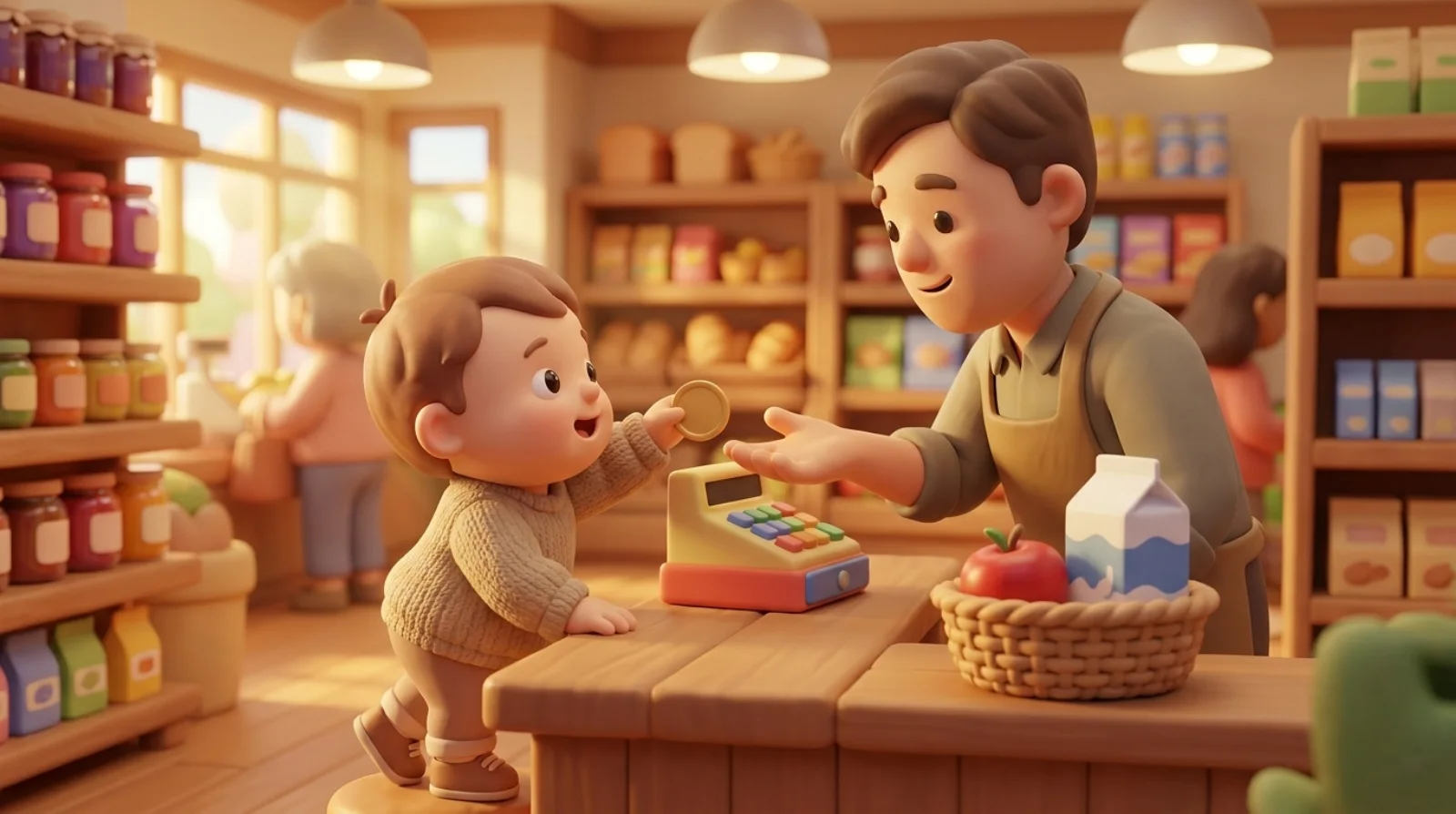
Your four-year-old hands the coins to the cashier. His fingers are sticky — there was a banana earlier, you can still see the evidence on his thumb. He places each coin on the counter with ceremony. One. Two. Three.
The cashier sweeps them into the register.
His eyes go wide. “Where did my money go?”
You kneel down. The floor is cold through your jeans. “It went to pay for the crackers. The crackers are yours now.”
He looks at the crackers. Looks at the register. Looks at his empty hand.
“But I want my money back.”
That’s the moment abstract becomes concrete. He just learned that money is not permanent — it transforms into things. No lesson plan required. Just a sticky-fingered kid, three coins, and a patient cashier.
At the kitchen table (ages 9—12)
She’s saved $23 in a jar. She wants a $30 book set — the one with the dragon on the spine that her friend has. Saturday morning, sitting at the kitchen table, counting.
“$23… I need $7 more.”
You watch her face. The morning light catches the jar. Coffee is getting cold in your mug — you forgot about it ten minutes ago. She’s doing math. Not school math. Math that matters.
“How long until I have $7 more?”
You do the math together. Her allowance is $3 a week. Two weeks and one day. She writes the date on a Post-it note and sticks it on the jar.
That Post-it note is doing more for her financial education than any worksheet you could download. She just learned to plan, to wait, and to measure progress toward a goal she chose herself.
Simple activities that actually teach
The best lessons I know cost nothing and fit into the day you’re already having:
- The three-jar system (spend / save / give) makes abstract choices physical for younger kids — they can see the trade-off.
- Let them buy the thing — and run out. The cleanest lesson about budgeting is spending it all and feeling the gap. Small stakes now save big ones later.
- Narrate your own choices. “I’d love that, but it’s not in the budget this month” teaches more than any worksheet.
- Set one real goal. A toy, a game, a trip. Saving toward something they chose turns waiting from a punishment into a strategy.
- Talk about giving. Money isn’t only spend-or-save; deciding to give some away is part of the picture.
Let the small mistakes happen
The instinct to rescue is strong — to top up the jar so the disappointment doesn’t land. Resist it, gently. A five-dollar mistake at eight is a cheap teacher; the same lesson at twenty-eight is expensive. The OECD’s 2022 PISA financial-literacy assessment of 15-year-olds across 20 countries found that students who actively save and compare prices score significantly higher than peers who don’t — and that 18% of students in OECD countries still lack basic financial proficiency, often because they never practised real money decisions early enough.3
I don’t think your job is to prevent every error. It’s to be there afterward, calm, to talk it through: what happened, what would you do differently? That conversation is the actual financial education.
Age-appropriate money moments
These aren’t lessons — they’re opportunities. Situations you can create (or notice) that let money become real:
- Ages 3—5: Let them hand cash to the cashier. Use a clear jar instead of an opaque piggy bank. Play “store” with real coins and real snacks.
- Ages 6—8: Give them a small budget for one thing at the grocery store — their snack for the week. Let them choose between two options at different prices.
- Ages 9—12: Put them in charge of the family movie night budget ($20 for snacks and rental — they decide the split). Let them comparison-shop online for something they want.
- Ages 13—15: Have them plan the cost of one family meal — shopping, cooking, the full loop. Let them manage their own clothing budget for a season.
- Ages 16—18: Walk them through one of your real bills — not to scare them, but to show how an adult budget actually works. Let them pay for their own recurring expense (phone plan, gas, streaming).
None of these require a lecture. They require a parent who’s willing to slow down, hand over some control, and let the child hold real money in a real situation.
When the whole family is on the same page
Teaching kids about money gets muddled when one parent says “save it” and the other quietly tops up the jar — or when grandparents hand over cash with no plan attached. Kids read the inconsistency instantly. T. Rowe Price’s annual Parents, Kids & Money Survey — sampling over 2,000 families with children aged 8—14 — found that kids who regularly discuss saving and spending goals with their parents are nearly twice as likely to consider themselves “smart about money” as kids whose families avoid the topic.4 I’m convinced the lessons land best when the adults share one approach: the same rules about allowance, the same answer at the checkout, the same goals on the fridge.
The movie ticket
Your teenager pays for his own movie ticket with money he earned mowing lawns. Three weekends of early mornings, wet grass, a mower that pulls to the left.
He holds the ticket between two fingers. Looks at it. Doesn’t say anything.
You’re standing next to him in the lobby. The carpet is that weird theater pattern — swirls on dark red. Popcorn smell. The ticket cost $12.50.
He slides it into his pocket carefully, like it weighs something.
You don’t say anything. You don’t need to. He just learned what money feels like when you earned it. No lecture in the world teaches that.
Start here
This week: let your child pay for ONE thing with real money. That’s it.
Not a big purchase. Not a teaching moment you announce. Just hand them the cash or the coins, let them walk up to the register, and let them make the exchange themselves.
Watch what happens. Watch their face when the money leaves their hand. Watch how they hold what they bought.
That’s the whole lesson.
The checkout line is the classroom. The coins in small hands are the textbook. And the parent standing quietly nearby — not lecturing, not rescuing, just present — is the best teacher money can’t buy.
Pause
That’s part of what I’m building ParentOS for — a family organization app designed to reduce the mental load of parenting. Allowance tracking, savings goals, and shared family responsibilities live in one place both parents can see, so money lessons stay consistent instead of depending on who happens to be at the register.
ParentOS is an adaptive family operating system where your family’s data stays yours — privacy first, no ads, and your data is never sold. If you’re looking for a calmer way to organize family life — join the early access.
Frequently asked questions
At what age should I start teaching kids about money? As early as preschool. Research from the University of Cambridge found that children’s core money habits are largely formed by around age seven,1 so the everyday moments you’re already living — paying at the store, saving coins in a jar — are the early lessons. Match the depth to the age.
What’s the best way to teach a young child about money? Make it physical and concrete. A clear jar to watch savings grow, handing over real coins at the register, and a single small goal to save toward teach far more than explanations at that age.
Should I tie money lessons to chores? It’s a personal choice. Some families pay an allowance for certain jobs; others keep allowance separate and treat chores as part of belonging to the family. Either can work — what matters most is consistency between both parents.
How do I teach a teenager to budget? Give them real money to manage — an allowance or earnings — plus a simple monthly plan tracking what comes in and goes out. Let them make and recover from small mistakes while the stakes are still low.
Sources
Related articles
Calm families start with shared awareness.
Footnotes
-
Whitebread, D. & Bingham, S. (2013). Habit Formation and Learning in Young Children. University of Cambridge, commissioned by the UK Money Advice Service. The report reviews over 100 studies and finds that children’s money habits are largely formed by around age seven. PDF. ↩ ↩2 ↩3
-
Amagir, A., Groot, W., Maassen van den Brink, H. & Wilschut, A. (2018). A review of financial-literacy education programs for children and adolescents. Citizenship, Social and Economics Education, 17(1), 56—80. Systematic review finding that experiential learning is the most promising approach for primary and secondary students, while classroom-only programs improve knowledge but show little effect on actual financial behavior. source. ↩
-
OECD (2024). PISA 2022 Results (Volume IV): How Financially Smart Are Students? Assessment of 15-year-olds in 20 countries. Found that 18 % of students in OECD countries lack basic financial proficiency, while students who save and compare prices score significantly higher; socio-economic background accounts for 12 % of performance variation. source. ↩
-
T. Rowe Price (2020). 12th Annual Parents, Kids & Money Survey. Survey of 2,030 parents and 2,030 children aged 8—14. Found that kids who frequently discuss financial goals with parents are nearly twice as likely to rate themselves “smart about money” (63 % vs. 35 %), yet 41 % of parents still feel reluctant to talk about finances at home. source. ↩