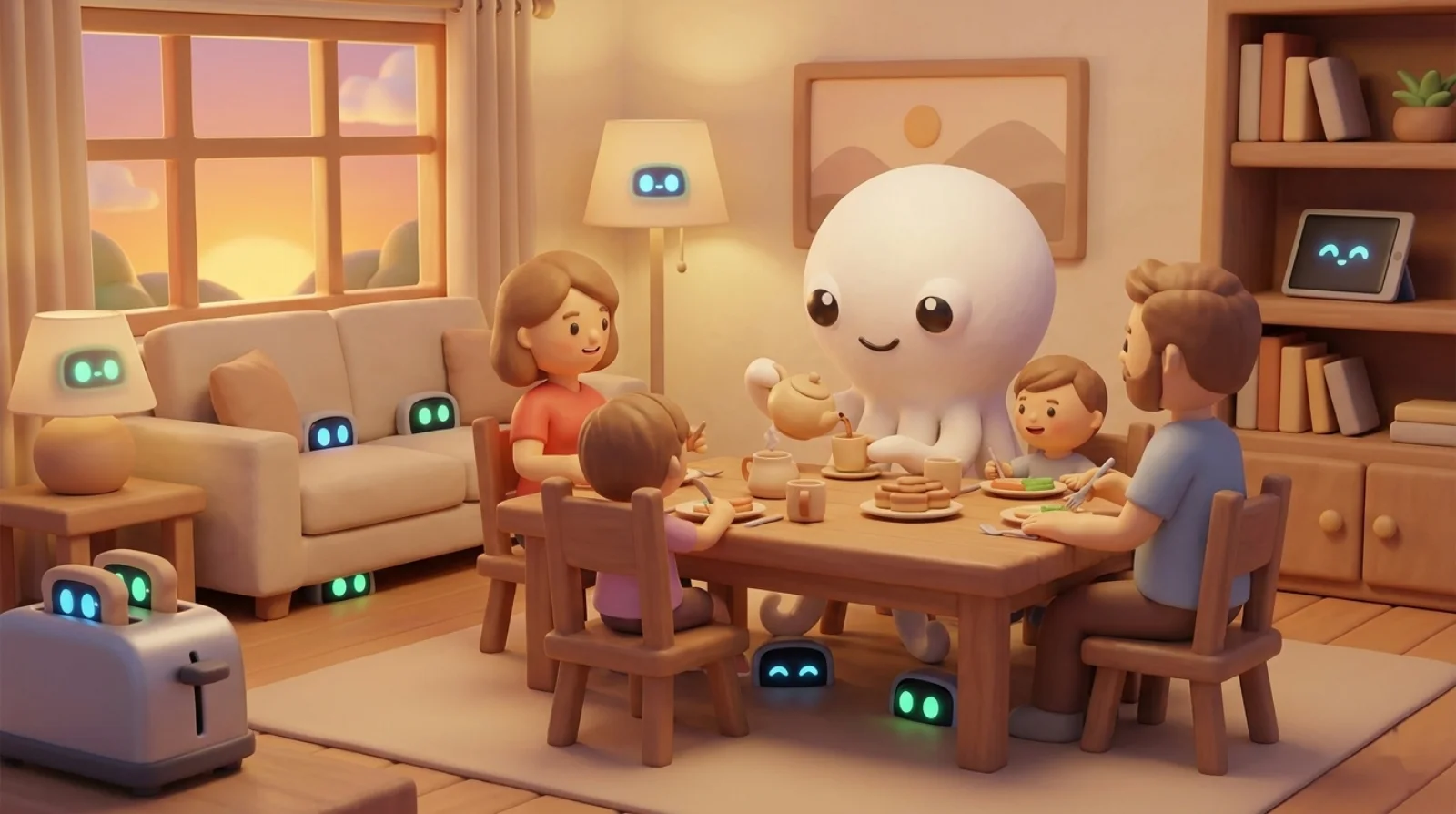
Family in the Age of AI: How to Prepare for What's Coming Anyway
Pillar: Slow Tech | Reading time: ~7 min As of: March 2026
Artificial intelligence is already in your home — in your phone, in your search engine, in your voice assistant. The question isn’t “will AI reach your family,” but “how do you prepare for it.” This article doesn’t ask you to be a technology expert. It only asks for calm, awareness, and a few concrete decisions.
Do you know this moment?
You’re sitting on the couch with your five-year-old. Together you ask Google about dinosaurs. Then about why the Moon is sometimes big and sometimes small. The answers appear instantly — faster than you can think.
You feel two things at once. In your chest — something warm: my child is curious, asks questions, looks for answers with me. And right next to it — a slight tightening in your stomach: should I be controlling this more? Is it too little, or too much?
Your heart speeds up a little. You think: “Am I being overprotective? Or am I not keeping a close enough eye on this?”
If that sounds familiar — this article is for you.
AI is already in your home — and that’s not bad news
Let’s start with the facts.
40% of children under the age of two already have access to a tablet [Common Sense Media, 2025]. By the age of eight, more than half have a mobile device of their own. In Poland, nearly 100% of households with children have internet access [GUS (Statistics Poland), 2024].
AI isn’t coming. AI is here.
It’s in the autocorrect in your messages, in YouTube’s recommendations, in spam filtering, in your car’s navigation. The Stanford Human-Centered AI Institute, in its 2025 report, makes it clear: artificial intelligence isn’t science fiction. It’s an everyday tool — like a washing machine or a car [Stanford HAI, 2025].
UNESCO, in its 2024 AI Competency Framework, defines the ability to use AI as one of the key competencies of the 21st century. Not an “extra.” Key [UNESCO, 2024].
That means one thing: AI will arrive whether or not you prepare. But preparing gives you peace of mind.
We’re not writing this to scare you. We’re writing to inform you.
Two approaches: Panic vs. Calm

When a new technology shows up, parents react in one of two ways.
| The panic approach | The calm approach | |
|---|---|---|
| Reaction | ”Turn that off right now!" | "Show me what you’re doing” |
| Assumption | AI = threat | AI = tool (it can help, it can harm) |
| Strategy | Bans and blocks | Awareness and conversation |
| Result | The child learns in secret | The child learns with a parent |
Both approaches come from care. But they lead in different directions.
The National Academies of Sciences, in their 2024 analysis — the most comprehensive review of research on technology and youth health — reached a conclusion worth remembering: the link between technology and mental health is far more complex than it seems. Some features harm. Others help. Context decides [National Academies, 2024].
Andrew Przybylski of Oxford studied more than 120,000 English teenagers and found something he called the “Goldilocks” effect: moderate use of technology isn’t harmful — and may be beneficial. The negative effect of excessive use turned out to be small, comparable to one third of the impact of regular sleep [Przybylski & Weinstein, 2017].
You don’t have to be a technology expert. You have to be present.
If you’re feeling right now that you’re not doing enough — pause. You’re reading this article. That is already conscious parenting.
5 principles for a calm approach to AI in the family
1. Together, not alone
A child shouldn’t be alone with AI. Use it together. Ask together. Evaluate the answers together.
The American Academy of Pediatrics, in its updated “5 C’s” framework from 2026, moved away from rigid time limits. The key takeaway: conversation (Communication) matters more than limiting time [AAP, 2026].
A meta-analysis of 88 studies published by Elsevier in 2025 backs this up with numbers: using technology together (co-use) has the largest positive effect on a child’s digital well-being. Not control. Not bans. Using it together.
When you and your child ask a voice assistant something — talk about the answer. Listen to it together. Decide together whether it makes sense.
2. Questions before answers
Before the AI answers, ask your child: “What do you think?”
AI delivers answers in a fraction of a second. That’s convenient. And a little dangerous — because it teaches that every question has an instant, ready-made answer.
UNESCO, in its AI Competency Framework, identifies critical thinking about AI as one of the key competencies of the 21st century [UNESCO, 2024]. That doesn’t mean your child has to understand algorithms. It means they should be able to ask: “How do you know that? Is that true? Are there other answers?”
One simple sentence: “Before we ask the robot — tell me what YOU think.” That’s enough.
3. Calm before alarm
When your child does something “dangerous” with technology — asks a strange question, sees something inappropriate, writes something silly — your first reaction matters.
If you react with panic, your child learns one thing: to hide.
The APA (American Psychological Association), in its 2023 report, is clear in its recommendation: monitoring combined with conversation is more effective than pure restriction [APA, 2023].
“What did you see?” instead of “Why were you doing that?”
“Tell me about it” instead of “Give me that phone.”
Calm doesn’t mean indifference. Calm means: I’m here, I’m not judging, let’s talk.
4. Fewer screens, more quiet
AI in the family doesn’t mean more screens. It means using the ones you already have more wisely.
One tool that helps — instead of five apps fighting for your attention. One place where you see what matters — instead of ten notifications a day.
A study published in PNAS Nexus (Oxford, 2025) shows that always-on connectivity generates stress. Quiet isn’t the absence of technology. Quiet is a feature [PNAS Nexus, 2025].
Agree with your partner: when do the phones “go to sleep”? Maybe at meals. Maybe an hour before bed. It doesn’t have to be a revolution. One hour of quiet a day is enough.
5. Forgive yourself
You won’t always be the perfect “digital parent.” You’ll scroll too long. You’ll order food from an app instead of cooking. You’ll answer an email in the middle of playtime.
That’s normal. And that’s OK.
A study published in Frontiers in Psychology (2024) shows that parents’ guilt about their phone use makes them feel worse — and, paradoxically, lowers the quality of their parenting. Forgiving yourself works the other way [Frontiers, 2024].
Being a good parent in the age of AI doesn’t mean being perfect. It means being aware — and gentle with yourself.
What AI won’t replace
AI will answer a question. But it won’t give a hug.
AI will generate a bedtime story. But it won’t sense that tonight your child needs a shorter one — because they’re tired, even though they won’t say so.
AI won’t say: “I can see you’re sad.”
AI won’t sit with you in silence when silence is what you need.
AI doesn’t know your child better than you do. It doesn’t know the tone of their voice when they’re lying. It doesn’t know the look on their face when they’re scared. It doesn’t know that today was a hard day at preschool because their shoes were too tight and a friend didn’t want to play.
The best technology for your family is the kind that gives you more time to be together. Not less.
Tool: The family technology card
Open the interactive technology card → — fill it in with your partner online and print it out.
Here are five questions to talk through with your partner. You don’t need perfect answers. You need shared answers.
Our family and technology — 5 questions to start with:
- When do the phones “go away”? (e.g., meals, bedtime conversations, sleep time)
- When is AI OK? (e.g., looking up answers to your child’s questions together, making up stories together)
- What do we do when our child sees something inappropriate? (an agreed response — calm, the question “what did you see?”, a conversation without judgment)
- How many “quiet hours” do we want each day? (no screens at all — even just one)
- How do we forgive ourselves for slip-ups? (because there will be some — and that’s normal)
Write the answers down anywhere — a piece of paper, a note on your phone, a WhatsApp message to each other. What matters is that you both know. It doesn’t have to be pretty. It has to be shared.
Inspired by: AAP Family Media Plan [AAP, 2016]
One micro-step for today
Tonight, at dinner, ask your child:
“What would you like to ask the robot today?”
Listen to the answer. Don’t judge. Then ask together — a phone, a speaker, a computer. See what it says. Talk about whether that answer makes sense.
That’s all. One step. No revolution.
Read also
- Generation Beta: Your Child Will Be Born Into a World Where AI Already Exists. And That’s OK. — a practical parent’s guide to the age of AI
- The Phone Can Wait: Why 145,000 Families Promised Each Other Not to Give Kids Smartphones — why 145,000 families promised not to give their kids smartphones
- Calm AI: When Artificial Intelligence Soothes Instead of Scares — AI that informs instead of alarming
What’s next?
ParentOS is an adaptive operating system for families, designed around calm, not panic. Your day at a glance. No surprises.
If that sounds interesting — parentos.ai
FAQ
At what age should I start talking to my child about AI?
From the moment your child starts using devices — in practice, around age 3-4. The conversation doesn’t have to be complicated. “This speaker doesn’t think like you and me. It repeats what it was taught.” That’s enough to start. UNESCO recommends building AI competencies gradually, from “understand” through “apply” to “create” [UNESCO, 2024].
Is AI safe for children?
It depends on the context. AI as a tool for looking up answers together — yes. AI as a child’s solitary emotional companion — that’s where real risks appear. Research from the MIT Media Lab shows that children attribute emotional states to AI and form relationships with it [MIT, 2019-2024]. The EU AI Act of 2024 bans AI systems that exploit age-related vulnerability [EU, 2024]. The key principle: together, not alone.
How do I limit screens without constant fights?
Instead of saying “turn it off,” set the rules together — when screens are OK and when they “go away.” The AAP is moving away from rigid time limits toward a conversation about quality: what you’re watching, with whom, and instead of what [AAP, 2026]. Children follow rules better when they helped create them. The family technology card (earlier in this article) is a good starting point.
Should I ban my child from using ChatGPT?
A total ban rarely works in the long run — your child will run into AI anyway, at school, at friends’ houses, in apps. A better approach: use it together. Show your child that AI makes mistakes. Ask it about something you both know — and check the answer. That builds critical thinking more effectively than a ban. In Poland, a phone ban has applied in primary schools since September 2026 [MEN (Poland’s Ministry of National Education), 2026] — but that’s about devices at school, not about learning how technology works.
What is “digital parenting”?
It’s a conscious approach to technology in the family. It doesn’t mean being an IT expert. It means three things: (1) you know what your child uses, (2) you use it together when you can, (3) you talk about what you see online. Research on “technoference” [McDaniel & Radesky, 2018] shows that digital parenting starts with us — with how we use our own phones when our children are around.
Sources
-
Common Sense Media (2025). The 2025 Common Sense Census: Media Use by Kids Zero to Eight. commonsensemedia.org
-
Stanford HAI (2025). AI Index Report 2025 (7th ed.). Stanford University. hai.stanford.edu
-
UNESCO (2024). AI Competency Framework for Students. unesco.org
-
National Academies of Sciences, Engineering, and Medicine (2024). Social Media and Adolescent Health. DOI: 10.17226/27396. nationalacademies.org
-
Przybylski, A.K. & Weinstein, N. (2017). A Large-Scale Test of the Goldilocks Hypothesis. Psychological Science, 28(2), 204-215. DOI: 10.1177/0956797616678438
-
American Academy of Pediatrics (2026). Updated Screen Time Recommendations: 5 C’s Framework. edsurge.com
-
American Psychological Association (2023). Health Advisory on Social Media Use in Adolescence. apa.org
-
GUS — Statistics Poland (2024). Społeczeństwo informacyjne w Polsce w 2024 roku (Information Society in Poland in 2024). stat.gov.pl
-
OECD (2024-2025). Children & AI Design Code / AI Literacy Framework. oecd.ai
-
EU AI Act (2024). Regulation 2024/1689. lcfi.ac.uk
-
MIT Media Lab (2019-2024). Kids’ Relationships and Learning with Social Robots. Personal Robots Group. media.mit.edu
-
McDaniel, B.T. & Radesky, J.S. (2018). Technoference: Parent Distraction with Technology and Associations with Child Behavior Problems. Child Development, 89(1). PMC
-
MEN (Poland’s Ministry of National Education) / Minister Barbara Nowacka (2025-2026). Phone ban in primary schools from September 2026. glos.pl
-
AAP (2016, updated). Family Media Plan. healthychildren.org
-
Resnick, M. (2024). Generative AI and Creative Learning. MIT Press / MIT Media Lab. medium.com
Calm families start with awareness.