ADHD and Technology: How to Spot an App That Respects Your Brain
Pillar: Neurodivergent Families (pillar page) Reading time: ~5 min As of: March 2026
TL;DR: Most apps are designed for a neurotypical brain — they assume linearity, consistency, and routine. If you have ADHD and no organization app has ever worked for you, you are not the problem. An ADHD-friendly app doesn’t punish inconsistency, doesn’t bury you in notifications, and lets you start with one thing. Below: a checklist you can run any app through, plus the research behind it.
10:40 PM
It’s 10:40 PM. You’re lying in bed. Your kid is finally asleep.
You have three tabs open on your phone: “ADHD app for kids,” “how to get organized with ADHD,” “is it normal that I can’t…”
You closed one before you got around to reading it. Your thumb keeps scrolling. Your eyes are closing on their own.
You landed here. Stay a moment.
Executive dysfunction BY DESIGN — why don’t most apps work for the ADHD brain?
Researchers at the ACM accessibility conference (2024) put it plainly: “executive dysfunction by design” — interfaces that demand constant attention, complex navigation, and sequential planning discriminate against users with ADHD [15].
Why? Because ADHD isn’t a matter of “just focusing harder.”
Barkley (1997) described ADHD as a disorder of behavioral inhibition that cascades into executive functions — working memory, self-regulation, planning [1]. Volkow and her team at the NIH (2009) went further: PET imaging showed reduced dopamine markers in the reward pathway of adults with ADHD [2].
This is not about willpower. This is about neurochemistry. Your brain literally processes reward and motivation differently.
Imagine trying to read a book on a streetcar at rush hour. Everyone around you is talking, phones are ringing, someone next to you is eating chips. Most apps are that streetcar — full of stimuli fighting for your attention.
An ADHD-friendly app is a quiet library.
You don’t have to remember all of this
The important part is in bold. If you’re reading this at 10:40 PM with your eyes closing, scroll to the checklist. The rest can wait.
What makes an app ADHD-friendly?
Five traits. No more.
1. Simplicity — 3 seconds to the information
You open it. You see what matters most. You close it. No 5 screens, 20 options, 3 menus.
Research: INTERACT 2025 — an ADHD-friendly redesign improved the experience for people with ADHD and without. The “curb cut effect” — designing for one group helps everyone [14].
2. Flexibility — it still works after a 3-day break
No “We miss you! Your streak is over!” When you come back, everything works.
Research: Safren et al. (2005, 2010, Harvard/MGH) — CBT for ADHD is built on “compensatory strategies,” not on consistency [16][17]. External scaffolding is therapeutic. It is not a crutch.
3. No shame prompts
(More on this below — it matters more than you think.)
4. Collaboration — someone else can enter it for you
“Shared awareness > individual memory.” If a partner, parent, or therapist can add something to the system, your working memory gets a rest.
Research: Bond & Titus (1983, 241 studies): the presence of another person affects how we perform tasks [39]. That’s the scientific basis of “body doubling” in ADHD. Shared awareness in an app is digital body doubling.
5. Calm instead of alarm
Instead of red badges — calm states. A day can be calm, moderate, or full. That’s a description, not a grade.
Research: Kushlev et al. (2016, ACM CHI, 221 participants): notifications trigger ADHD symptoms even in neurotypical people [40]. For someone with ADHD, the effect is amplified. More on this: Calm AI: When Artificial Intelligence Soothes Instead of Scares.
What does this look like in practice?
| Typical app | ADHD-friendly app | |
|---|---|---|
| Notifications | 12 alerts a day, red badges | A summary in the morning and in the evening |
| After a 3-day break | ”We miss you! Your streak is over!” | Nothing. When you come back, everything works |
| Onboarding | ”Fill out your profile, add goals, set up a weekly plan" | "Start with one thing. The rest can wait” |
| Language | ”You didn’t reach your goal!” / “Streak lost!" | "A day without surprises” |
| Collaboration | Everyone keeps their own list | Shared awareness > individual memory |
Shame prompts and your brain — why “We miss you” hurts
Researchers describe it as “dysregulated not deficit” (2023) — people with ADHD show significantly higher sensitivity to rejection and injustice [36].
It has a name. Rejection Sensitive Dysphoria (RSD).
A 2014 study confirmed it: participants with ADHD reported significantly higher rejection sensitivity — both the anxious kind and the angry kind [37]. A 2024 machine-learning analysis showed that emotional dysregulation is an independent predictor of functional impairment in ADHD [38].
“You haven’t filled in your journal 5 days in a row!” — for a neurotypical person, that’s information. For a person with ADHD, it’s a punch to the gut. That’s not an exaggeration. That’s neurobiology.
An ADHD-friendly app NEVER punishes you for being away.
QUICK CHECK — 3 questions to start
- Can I open this app and know what matters within 3 seconds?
- Does the app still work when I haven’t used it for a week?
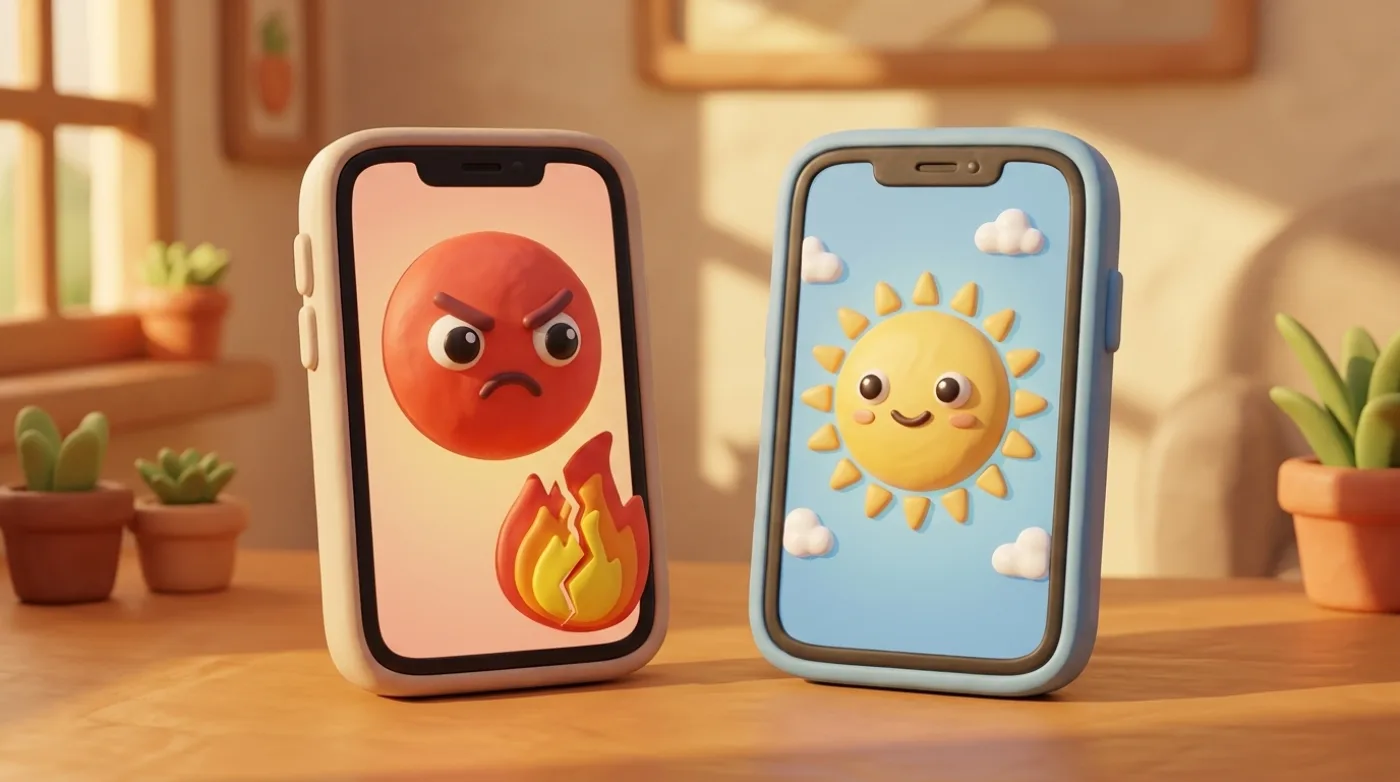
- Does it tell me things calmly, or does it shout with red alerts?
If you answered “no” to 2 out of 3, this isn’t an app for your brain. And that’s not your fault.
You can stop here
What’s above is the most important part. The rest is for those who want to dig deeper. Come back tomorrow if you’d rather.
Time blindness — why “time management” doesn’t work for the ADHD brain
Barkley (1997) defined “time blindness” — blindness to the past, the future, and time in general [20]. It’s not a metaphor. It’s a core deficit of ADHD.
A review covering a decade of research (2023) confirmed it: time perception is consistently impaired in adults with ADHD, especially over longer intervals [21]. A 2021 study went further: difficulty perceiving time is a focal symptom of adult ADHD, not a side effect [22].
“Just use a calendar” is like telling a nearsighted person to “just look more carefully.” You need a tool that SEES time for you.
An ADHD-friendly app has to externalize time. Show visually how much of it is left. Give reminders with context — not “in 15 minutes,” but “leave now to make it on time.”
74% — why the whole family needs support
Faraone & Larsson (2019, Molecular Psychiatry): ADHD is 74% heritable [6]. It’s not a “personality trait” — it’s genetics.
Biederman et al. (2002, Harvard/MGH): when a parent has ADHD, the child is at significantly higher risk. Families with ADHD show more family conflict and lower cohesion [29].
Faraone et al. (2021, 79 authors, 27 countries, 208 conclusions): “A worldwide consensus — ADHD affects 5-7% of children and 2.5-5% of adults globally” [33].
If your child has ADHD, there’s a good chance you do too. Or your partner. Or both of you. It isn’t one person who needs a better app. It’s the whole family that needs a system that understands how you work.
Shared awareness > individual memory. Digital body doubling for the whole family [39].
The full checklist: Is this app ADHD-friendly?
Open the interactive checklist → — tick the boxes online and print your result. (The interactive version is in Polish.)
You don’t have to go through all 10 points at once. Check the first 3. The rest can wait.
NOTIFICATIONS
- Can I turn off ALL notifications and still use the app?
- Does the app have a “summary” mode instead of constant alerts?
SIMPLICITY
- Do I see the most important information within 3 seconds of opening it?
- Can I get something done in the app in FEWER than 3 taps?
FLEXIBILITY
- Does the app still work when I haven’t used it for 3 days? (Does it not punish me? Does it not send “we miss you!”?)
- Can I start with ONE feature, not all of them at once?
PERMISSION
- Does the app NOT use “shame prompts”? (E.g., “You haven’t filled in your journal 5 days in a row!”)
- Can I skip a step or a stage without getting blocked?
COLLABORATION
- Can someone else (a partner, a parent) add things for me?
- Does the app have a “simple view” mode / fewer stimuli?
SCORE:
- 8-10: This app respects your brain.
- 5-7: It’s OK, but it could be better. Check the notification settings.
- 0-4: This app was designed for someone else. And that’s not your fault.
Who sees the data about your child’s ADHD?
Journal of Law and the Biosciences (2022): behavioral data from apps (task-completion patterns, timing patterns) may qualify as “health data” under Article 9 of the GDPR — even when it isn’t explicitly medical [30].
JAMA Health Forum (2020): U.S. health privacy rules do NOT cover data collected by consumer apps [31].
If an app knows that your child struggles to finish tasks, forgets medication, and has irregular sleep patterns — that is a neurodivergence profile. Who gets to see it?
A quick word on encryption in ParentOS: finances, health records, calendar, tasks, shopping, meals, education and wellbeing are end-to-end encrypted on your device, and the server stores only ciphertext. Medication names, doses and routines are not covered by that encryption today, and the server can still see some metadata, such as dates and which family member an entry belongs to.
What if nothing has worked so far?
That’s normal. Most tools weren’t designed with your brain in mind.
A meta-analysis of 25 RCTs (2024, n=1780): digital interventions SIGNIFICANTLY reduce ADHD symptoms compared with controls [7]. Digital tools DO WORK — as long as they are well designed.
One piece of advice: instead of looking for “the best app,” look for the app that gets in your way THE LEAST. Not the one with the most features. The one with the calmest interface.
ParentOS was designed around shared awareness, not individual memory. One glance at the day. No surprises. If that sounds interesting — parentos.ai
FAQ
Is there one best app for ADHD?
No. The best one is the one that gets in your way the least. Look for simplicity, flexibility, and no shame prompts. Check the checklist above.
Do gamified apps help with ADHD?
Moderately. A meta-analysis of 27 RCTs (2024) shows an effect of g=0.28 [25] — gamification increases engagement, but it doesn’t improve cognitive outcomes [26]. It can be one ingredient, but not the solution.
Does having ADHD mean I can’t use any app at all?
No. 25 RCTs confirm that digital tools help [7]. The problem isn’t you — it’s the design. There are apps built with your brain in mind.
How do I explain to my partner why I need a different app?
“My brain processes reward and motivation differently [2]. It’s not about willpower — it’s neurobiology. I need a tool that doesn’t punish me for taking breaks and doesn’t bury me in notifications.”
Read also
- ADHD in the Family: When Everyone Forgets — why ADHD is a whole-family matter, not one person’s
- Calm AI: When Artificial Intelligence Soothes Instead of Scares — 5 traits of calm AI
Medical disclaimer
This article is for informational purposes only and is not medical advice. If you suspect ADHD in yourself or your child, talk to a specialist. In Poland, the Polish Psychiatric Association (Polskie Towarzystwo Psychiatryczne) maintains a register of specialists.
Sources
[1] Barkley, R. A. (1997). Behavioral Inhibition, Sustained Attention, and Executive Functions: Constructing a Unifying Theory of ADHD. Psychological Bulletin, 121(1), 65-94. DOI: 10.1037/0033-2909.121.1.65
[2] Volkow, N. D., Wang, G. J., Kollins, S. H., et al. (2009). Evaluating Dopamine Reward Pathway in ADHD: Clinical Implications. JAMA, 302(10), 1084-1091. DOI: 10.1001/jama.2009.1308
[6] Faraone, S. V. & Larsson, H. (2019). Genetics of Attention Deficit Hyperactivity Disorder. Molecular Psychiatry, 24, 562-575. DOI: 10.1038/s41380-018-0070-0
[7] Meta-analysis (2024). The Effect of Digital Interventions on ADHD: A Meta-Analysis of Randomized Controlled Trials (25 RCTs, n=1780). PubMed. https://pubmed.ncbi.nlm.nih.gov/39191306/
[14] INTERACT 2025. Towards Inclusive Guidelines for Web Design for Adults with ADHD. ACM. https://dl.acm.org/doi/10.1007/978-3-032-05008-3_59
[15] ACM SIGACCESS (2024). Executive Dysfunction by Design: A Cognitive Accessibility Analysis. ACM Conference on Computers and Accessibility. https://dl.acm.org/doi/10.1145/3663547.3749831
[16] Safren, S. A., et al. (2005). Cognitive-Behavioral Therapy for ADHD in Medication-Treated Adults. JAMA, 294(8), 875-880.
[17] Safren, S. A., et al. (2010). Cognitive Behavioral Therapy vs Relaxation for Medication-Treated Adults with ADHD. JAMA, 304(8), 875-880.
[20] Barkley, R. A. (1997). ADHD, Self-Regulation, and Time. Journal of Developmental & Behavioral Pediatrics, 18(4), 271-279.
[21] Review (2023). Time Perception in Adult ADHD: Findings from a Decade. PubMed. https://pubmed.ncbi.nlm.nih.gov/36833791/
[22] (2021). Time Perception Is a Focal Symptom of ADHD in Adults. PubMed. https://pubmed.ncbi.nlm.nih.gov/34272353/
[25] Meta-analysis (2024). Efficacy of Gamified Digital Mental Health Interventions (27 RCTs, n=2911). PubMed. https://pubmed.ncbi.nlm.nih.gov/39312259/
[26] (2020). The Effects of Gamification on Computerized Cognitive Training. JMIR Serious Games. https://pubmed.ncbi.nlm.nih.gov/32773374/
[29] Biederman, J., Faraone, S. V., Monuteaux, M. C. (2002). Impact of Exposure to Parental ADHD on Clinical Features in Offspring. Journal of Consulting and Clinical Psychology.
[30] (2022). Mental Data Protection and the GDPR. Journal of Law and the Biosciences. https://pubmed.ncbi.nlm.nih.gov/35496983/
[31] (2020). Health Policy and Privacy Challenges Associated with Digital Technology. JAMA Health Forum. https://pubmed.ncbi.nlm.nih.gov/32644138/
[33] Faraone, S. V., et al. (2021). The World Federation of ADHD International Consensus Statement: 208 Evidence-Based Conclusions. Neuroscience & Biobehavioral Reviews, 128, 789-818.
[36] (2023). “Dysregulated not Deficit”: Symptomatology of ADHD in Young Adults. PubMed. https://pubmed.ncbi.nlm.nih.gov/37824501/
[37] (2014). Justice and Rejection Sensitivity in Children and Adolescents with ADHD Symptoms. PubMed. https://pubmed.ncbi.nlm.nih.gov/24878677/
[38] (2024). Emotional Dysregulation in Emerging Adult ADHD. PubMed. https://pubmed.ncbi.nlm.nih.gov/39342440/
[39] Bond, C. F. & Titus, L. J. (1983). Social Facilitation: A Meta-Analysis of 241 Studies. Psychological Bulletin, 94(2), 265-292.
[40] Kushlev, K., Proulx, J., Dunn, E. W. (2016). “Silence Your Phones”: Smartphone Notifications Increase Inattention and Hyperactivity Symptoms. ACM CHI Conference.