Parental Burnout Is Worst in the Wealthy West — and It Isn't About Money
TL;DR: The countries with the highest parental burnout aren’t the poorest — they’re the wealthy, individualistic ones (the US leads, with Belgium and Poland close behind). Counterintuitively, burnout isn’t driven by the number of chores or kids, but by isolation: one parent carrying the family’s entire cognitive map alone. That isn’t a personal weakness — it’s a structural problem with structural fixes. And they start not with self-care, but with sharing the weight.
The Evening When You Feel Nothing
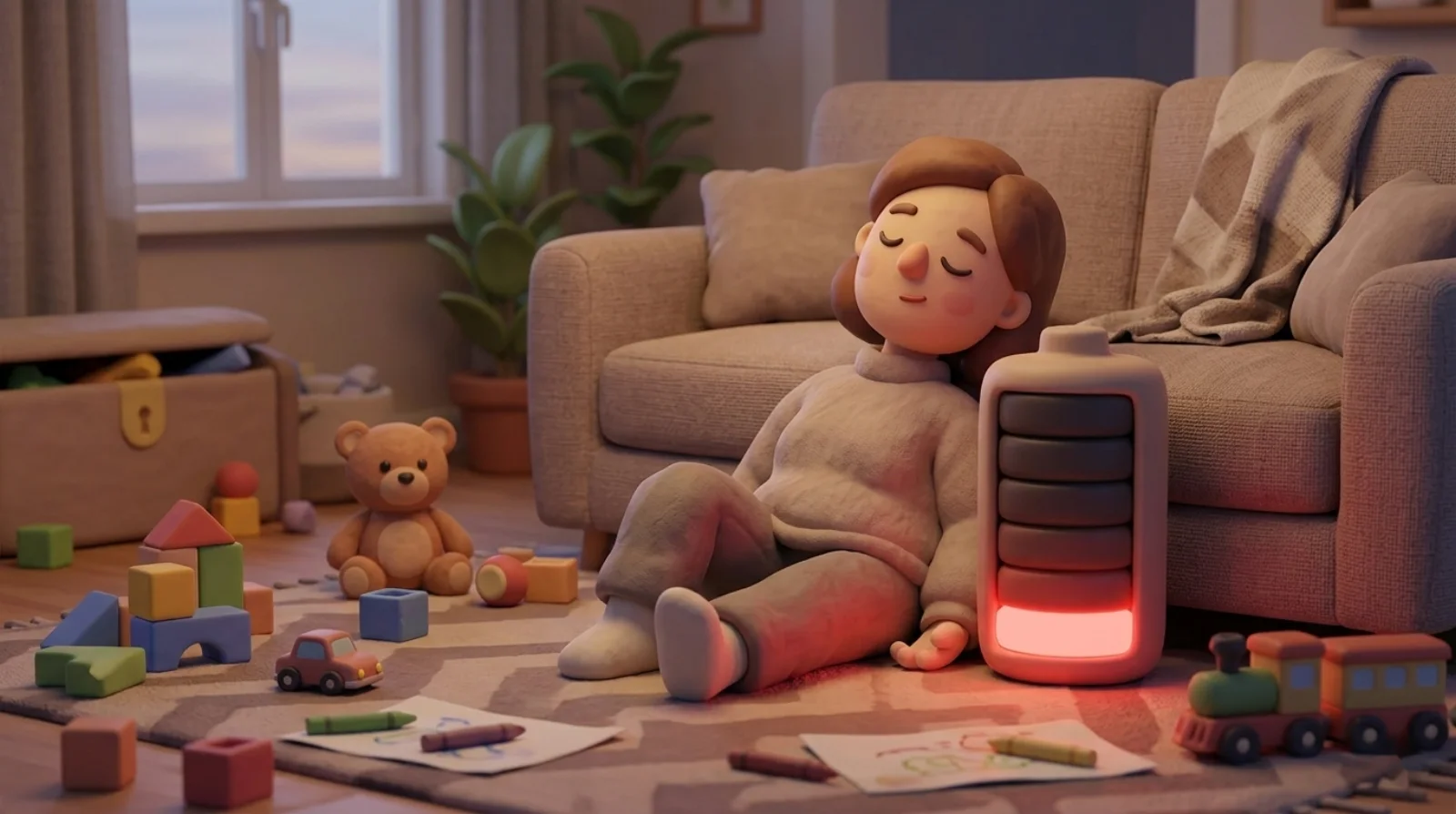
Your kid runs over to show you a drawing. You nod, say “nice,” and a moment later realize you didn’t actually look at it. Not because you don’t care. Because there’s nothing left.
This isn’t a dramatic breakdown. Burnout rarely looks like that. More often it’s quiet: you do everything on autopilot, through a fog, and by evening there isn’t a gram more in you. The joy went missing somewhere. What’s left is the tasks and the feeling that you’re the one engine that isn’t allowed to stall.
And on top of it comes a second layer — shame. “I wanted these kids. Everyone else manages somehow. What’s wrong with me?”
The answer, as usual in this series, is: nothing. You’re just carrying something that can’t be carried alone.
What Parental Burnout Is
Parental burnout isn’t momentary tiredness. It’s a state of chronic exhaustion in the parenting role, most often described with three components:
- Extreme exhaustion — physical and emotional, the kind sleep doesn’t repair.
- Emotional distancing from your children — you go through the motions, but the tenderness has switched off somewhere.
- A sense of being an incompetent parent — “I’m not cut out for this, I’m failing them.”
It isn’t the same as burning out at the office. You can leave a job. You can’t leave parenting — it’s 24 hours a day, no leave and no notice period. That’s why parental burnout can run deeper and quieter than the professional kind.
Why the Wealthy West
Here’s where the numbers matter.
A study spanning 42 countries (Roskam, Mikolajczak et al., published in Affective Science in 2021) measured parental burnout worldwide. The highest rates were in wealthy, individualistic countries: the United States (8.4%), Belgium (7.9%), and Poland (~7%) led the list (Parental Burnout Around the Globe, PMC).
Poland is a striking case study. Research by Dr. Konrad Piotrowski’s team at SWPS University found that roughly 13% of Polish parents admit to regretting the decision to have a child — noticeably more than in the US or Germany, where it’s estimated at 7-8% (SWPS University).
These aren’t numbers meant to scare. They’re numbers that say: if you feel this way, you aren’t an exception or a defective parent. You’re part of a pattern — and patterns have causes.
The Surprising Cause: Not Money, but Isolation
The most important finding of the 42-country study is counterintuitive. The highest burnout rates are not in the poorest countries, nor where families have the most children. They’re in individualistic cultures — wealthy, Western ones, where a parent largely faces the role alone.
In other words: burnout is driven not by the number of duties, but by how many people carry them with you. It used to be “the whole village.” Increasingly it’s one person — most often the mother — holding the family’s entire logistics, calendar, needs, and anticipation in her head. That’s the mental load we’ve written about before, stretched across years without a break.
The wider shift is the same everywhere the West has gone individualistic: the multigenerational “village” shrank, and nothing replaced the role it played.
It Isn’t Your Fault

Worth saying plainly, because the shame here can be paralyzing: regret, distance, the “I can’t do this” feeling — these aren’t evidence that you’re a bad parent. They’re symptoms of an overloaded system, not a flaw of the heart.
Regret over having a child — a taboo topic almost no one discusses — is usually not a rejection of the child. It’s a signal that a person is at their limit with nowhere to set the weight down. We confuse the two, so parents suffer in silence, convinced they’re the only ones who “feel this way.” They aren’t.
What Actually Helps
Not “self-care” in the bubble-bath-and-candle sense. That advice can be almost insulting in real burnout — because the problem isn’t that you rest too little, it’s that you carry too much alone.
Since the driver is isolation and unequal load, what helps is what reduces them:
1. Share the cognitive load, not just the tasks. “Helping” isn’t enough if you’re still the one who remembers, plans, and assigns. It means genuinely transferring whole domains — including the thinking about them. More on how to have that conversation in How to Share the Mental Load.
2. Rebuild the village — ask for help without shame. Grandparents, friends, neighbours, paid help if you can afford it. Asking for help isn’t a parenting failure. It’s restoring what the human brain has always assumed: that a child isn’t raised alone.
3. Lower the bar to “good enough.” A child doesn’t need a perfect parent. They need a present one — and presence is impossible when the chase for perfection eats everything. “Good enough” isn’t a compromise. It’s a survival condition.
Where Technology Can Help (and Where It Can’t)
Let’s be honest: no app cures burnout. Burnout is a state that sometimes needs a psychologist, rest, a life change — things software can’t replace.
But one of the structural drivers of burnout — carrying the family’s entire cognitive map alone — happens to be something you can distribute across more than one head. And there, a tool can take part of the weight.
We build ParentOS around the principle shared awareness > individual memory: one picture of the day that doesn’t hang on one overloaded head, but is visible to everyone who shares the care. It isn’t a cure for burnout. It’s an attempt to remove one of its quiet causes — the feeling that you’re holding everything in your head alone. One look at the day. No surprises. If you’re looking for a way to stop being the family’s only engine: parentos.ai.
Key Takeaways
- Parental burnout is highest in the wealthy West — the US (8.4%), Belgium, and Poland (~7%) lead the 42-country study; ~13% of Polish parents regret the decision to have a child (SWPS).
- Burnout isn’t tiredness — it’s extreme exhaustion, distance from your kids, and a sense of incompetence. A clinical state, not a weakness.
- The cause isn’t poverty or the number of kids — it’s isolation. The highest rates are in individualistic cultures where a parent carries the role alone.
- Regret and shame are symptoms of overload, not character flaws — and they don’t mean a lack of love for your child.
- What helps is what reduces isolation and load — sharing the mental load, rebuilding support, lowering the bar. Technology can take part of the weight, but it can’t replace rest or professional help.
If you’re reading this on your last reserves — you don’t have to fix anything today. It’s enough to know: it isn’t your fault, and you aren’t alone in it. If the regret or emptiness feels overwhelming, talking to a psychologist isn’t a last resort — it’s a sensible first step. And if you’re in acute distress, please reach out to a local crisis helpline or your doctor.
Related reads
- Mental Load in Families: The Complete Guide
- How to Share the Mental Load With Your Partner
- Are You the Default Parent?
Sources
[1] Roskam, I., Mikolajczak, M. et al. (2021). Parental Burnout Around the Globe: A 42-Country Study. Affective Science. PMC
[2] SWPS University, Dr. Konrad Piotrowski’s team — How many parents regret having children?
[3] Medycyna Praktyczna — Parental Burnout
Calm families start with awareness.