
The 10 PM Grade Alert: Why School App Notifications Spike Your Stress
Pillar: Slow Tech | Reading time: ~7 min As of: July 2026
TL;DR: A grade notification at 10 PM can ruin the evening — and it’s not a matter of “taking things too personally.” Your body responds to a sudden signal with a spike of cortisol, the same way it responds to a real threat. This is digital microstress: a single notification is small, but dozens a day keep the nervous system on alert. You don’t have to give up the school app. You just change one thing: when and how you let it speak to you.
10:03 PM. The Phone Buzzes.
You’ve just sat down. The kids are asleep, a mug of tea is cooling beside you, for the first time since morning you have a moment to yourself. The phone buzzes on the table. You glance reflexively: School app — new grade.
You open it. A failing mark on a math quiz.
And that’s it. The tea stops mattering. A queue of questions starts up in your head: why didn’t he say anything, did he not study, should you have kept a closer eye, will there be time to talk about it before school tomorrow. Your shoulders climb toward your ears. The evening that was meant to be yours has just turned into work.
The grade can wait until morning. The conversation can wait until morning. But your nervous system doesn’t know that anymore — it got a signal and reacted.
What Just Happened in Your Body
A notification isn’t neutral. A sudden sound or buzz triggers an orienting response in the brain — “what’s happening, is this a threat?” For signals that might carry bad news, the body answers with a release of cortisol, the stress hormone. A range of research on notifications suggests that even the expectation of a signal can raise arousal.
The problem is that the brain doesn’t distinguish “new grade” from “something bad is happening.” It responds to the form — the suddenness — not the content. That’s why a notification about a failing mark at 10 PM lands with a force out of all proportion to a matter that could calmly have waited until breakfast.
This is digital microstress: a single signal is trivial, almost unnoticeable. But when you get dozens of them across a day — from the school app, class chats, work, your partner — the nervous system never gets to stand down. No single alert is a catastrophe. Their sum tires the body like one big stressor.
Why the School App Is Uniquely Relentless
Grade portals did something that would have been unthinkable a decade ago: they gave parents a view of every grade, absence, and note in real time. A teacher enters a mark — the parent’s phone buzzes seconds later. In the evening. On the weekend. On vacation.
Three features make it especially heavy:
- Immediacy. The information arrives a second after it’s entered, at any hour — including when there’s nothing you can do with it.
- No urgency filter. A failing quiz mark and a genuine notice about early dismissal look identical in a notification. Everything carries the same alarm level.
- An invitation to constant surveillance. Since you can check grades non-stop, it’s easy to start — and fall into a refresh loop that feeds anxiety instead of soothing it.
It Doesn’t Mean You Care Too Much
Worth saying plainly: checking grades non-stop doesn’t come from being overzealous or controlling. It comes from care and from fear — you want to know, you want to be able to react in time, you want your child to do well. That’s understandable.
But parenting media and psychologists point to a pattern worth knowing: when a parent reacts to every single grade, there’s often more tension at home — and not necessarily better results (mjakmama24, a Polish parenting portal). Round-the-clock visibility and support aren’t always the same thing — and, importantly, that’s a matter of settings, not character.
This isn’t a charge against you. It’s information about how the tool was designed — and about the fact that you can set it up differently.
What You Can Do Today
This isn’t about cutting off from school. It’s about you deciding when school speaks to you — not the other way around.
- Turn off instant push notifications for grades and ordinary messages. If the app allows it, keep only genuinely urgent alerts on.
- Check the app at a set time, once a day. Research on email-checking (Kushlev and Dunn, 2015) found that limiting checks to a few scheduled moments a day clearly reduces daily stress. The same principle works with grades.
- Pick a time that serves you. For many parents that’s the early evening, calmly, over tea — not a reflexive glance at work or right before sleep.
- If both of you get notifications, that’s another source of noise. You don’t have to settle anything now. It’s enough that you turn off yours and check at your own time. And if a good moment ever comes, you can agree that one person watches the app — and the rest of the family breathes easier.
These are mostly settings changes, not a change of character — the first three take a minute each.
What You Can’t Set — and What to Do About It
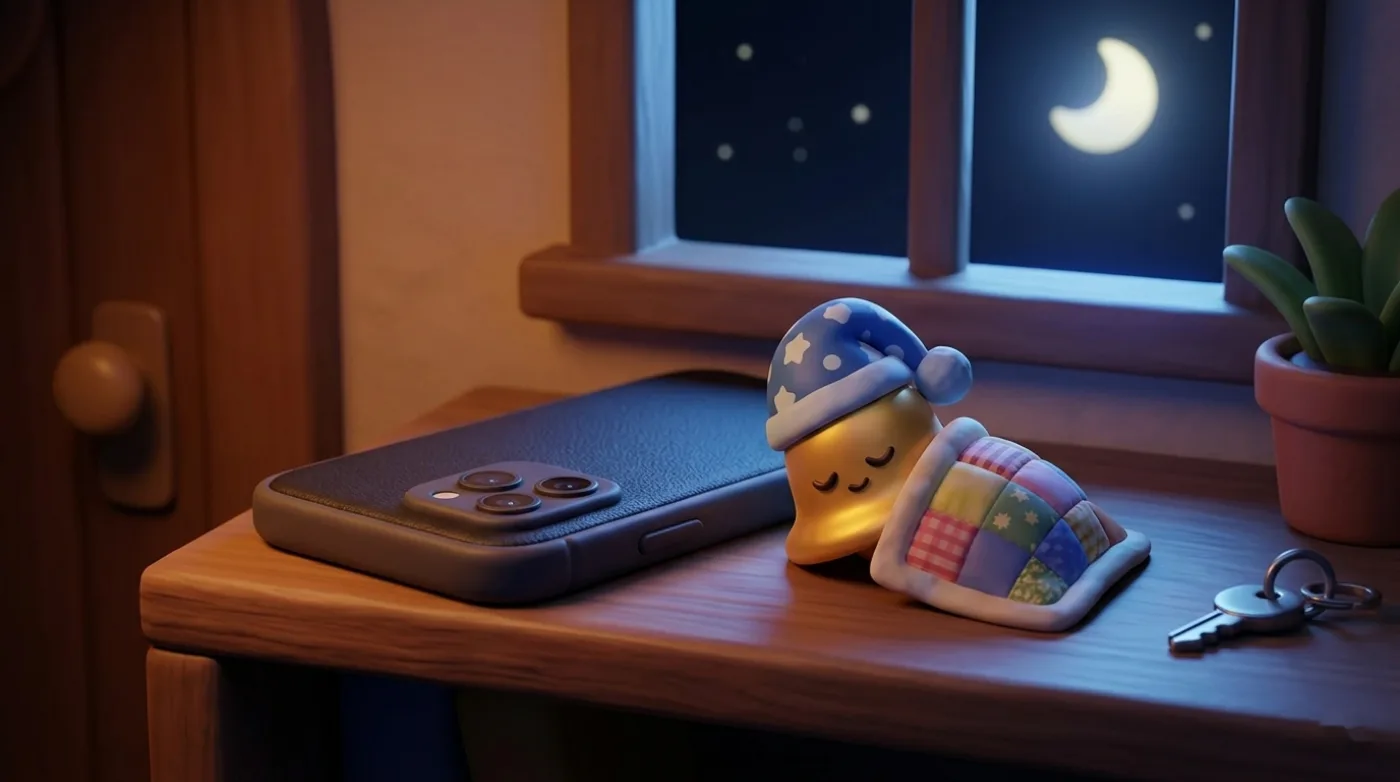
You can mute the school app. You can’t redesign how it works — because it isn’t your tool. And here’s a wider thought that reaches beyond the grade portal.
The technology that accompanies you in parenting does one of two things: it either chases you with notifications, or waits until you reach for it. The first keeps you on alert. The second gives you back control over when you let information into your head.
You can’t silence the school portal at the source — but the tools you choose to run your family don’t have to copy its logic. We design ParentOS around the principle Calm over alarm: the day’s information is there when you reach for it — one calm glance — not chasing you with red alerts at 10 PM. It won’t mute the school app for you. But at least the part of your tech that you do control can be a quiet center of gravity, rather than one more source of noise.
Because calm at home doesn’t start with caring less. It starts with getting back the decision of when you care.
Family tech that waits until you reach for it, instead of chasing you with alerts — parentos.ai.
Key Takeaways
- A grade notification at 10 PM triggers a real stress response — the body reacts to the suddenness of the signal with cortisol, regardless of how trivial the matter is.
- This is digital microstress — a single alert is small, but dozens a day keep the nervous system on constant alert.
- The school app is especially heavy — through immediacy, no urgency filter, and an invitation to round-the-clock surveillance.
- Constantly checking grades usually doesn’t help the child — it more often raises tension at home than results.
- Four settings change everything — turn off push, check at a set time once a day, pick a time for yourself, agree on who watches.
If you’re reading this in the evening with your phone in hand — you don’t have to change the settings now. Do it tomorrow, calmly. Nothing urgent is happening.
Related reads
- Calm AI: When Artificial Intelligence Soothes Instead of Scaring
- Slow Tech: When Technology Slows Down Instead of Speeding Up
- The Family Screen Plan: A Ready-Made Template
Sources
[1] Kushlev, K. & Dunn, E. W. (2015). Checking email less frequently reduces stress. Computers in Human Behavior, 43, 220–228. ScienceDirect
[2] Parents check grades non-stop — the effect: more arguments and less motivation, mjakmama24 (Polish parenting portal)
Calm families start with awareness.