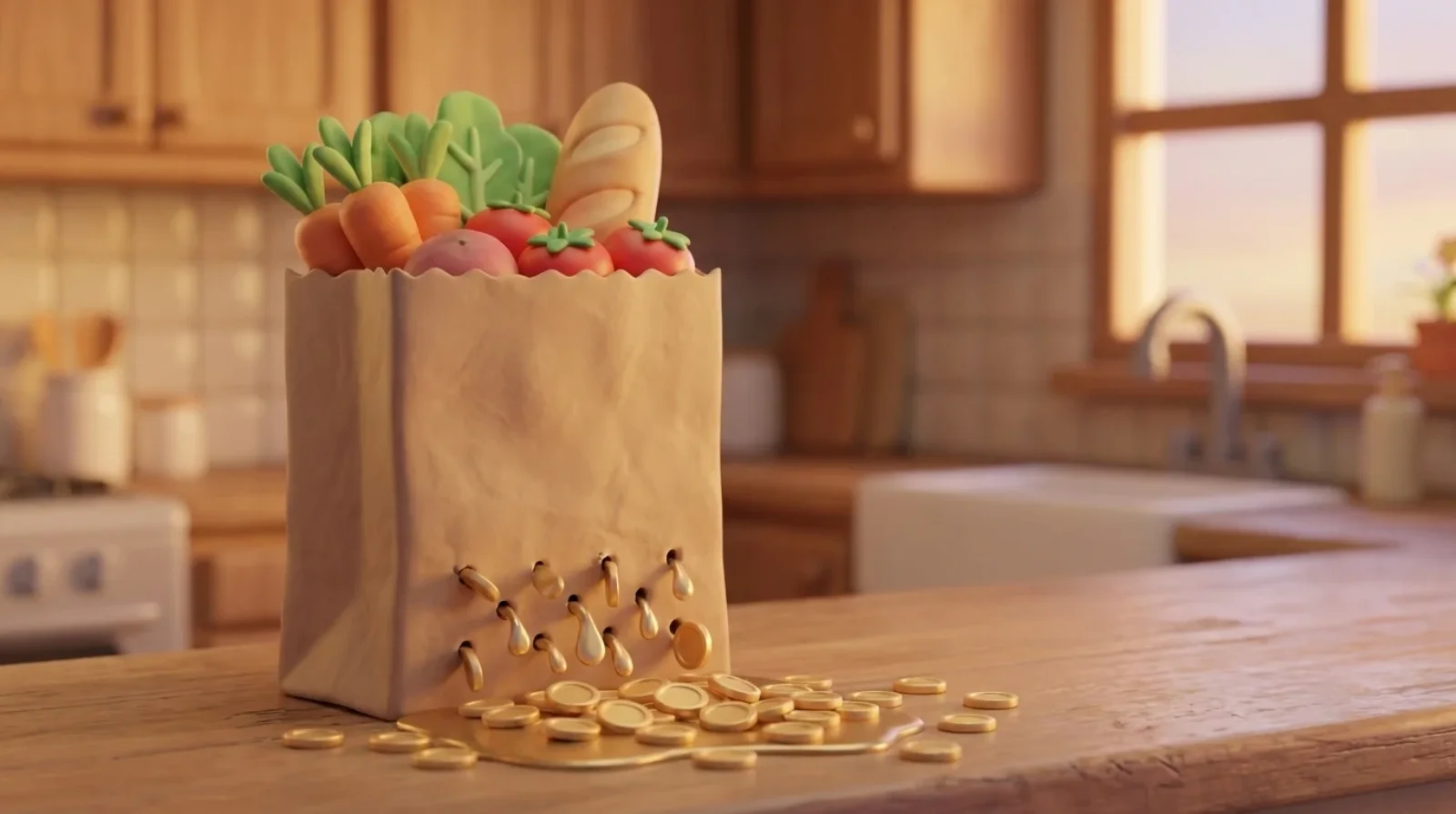
Budget Meal Planning for Family: How Forty Small Drips Drain the Grocery Budget
TL;DR: The biggest grocery savings don’t come from coupons or clipping deals — they come from one habit: deciding what you’ll cook before you shop. A weekly plan plugs the two most expensive leaks: throwing away food you forgot you bought, and the unplanned $40 trip that quietly becomes $90. Plan around what’s already in the fridge, build one list and shop once, lean on cheaper staples and “cook once, eat twice” meals, and you’ll spend noticeably less without eating any worse.
Wednesday, 5:50 PM
You’re standing at the deli counter because you didn’t plan dinner and the rotisserie chicken is $8.99. It’s fine. Except this is the third rotisserie chicken this week.
Last week it was takeout twice and one emergency pizza. You open the banking app on the way home. Groceries plus eating out: $287 this week. For what? A chicken, two pizzas, a bunch of random ingredients you bought “in case,” and a bag of spinach that is now a bag of green liquid.
The deli counter calls your number. You grab the warm plastic container — it’s almost too hot against your palm, the condensation fogging up the inside of the lid. The car radio is playing something you don’t hear. Your phone screen is cold in the other hand, the banking app still open.
The money leaked — not in one big pour, but in forty small drips, each one feeling like “just tonight.”
That’s how I see food overspend: it’s never one catastrophic mistake. It’s forty small decisions made tired and hungry, without a plan.
Where the money actually goes
You smooth the receipt out on the kitchen counter. $14 for the cheese you already had in the back of the fridge. $6 for the fresh rosemary you used a pinch of. $4.50 for the second bag of chips that wasn’t on the list. The receipt is a map of every decision you made while hungry, tired, and without a plan.
Two of the most expensive things a household does with food are invisible:
- Food waste. Food bought, forgotten, and binned is money thrown straight in the trash. The average American household of four loses roughly $2,900 a year to wasted food — about 11 percent of total food spending.1 Planning around what you already have is, in my view, the most direct way to shrink it.
- Unplanned trips. Every extra “I’ll just grab milk” run is an invitation to impulse buys. Fewer, planned trips with a list mean fewer things in the cart you didn’t intend to buy. That “quick stop” averages $30—50 above the item you went in for.
Up to 40 percent of food produced in the U.S. is never eaten, and households are the single largest source of that waste.2 A weekly plan attacks both at once: you cook what you bought, and you shop with intent. Recent research confirms that structured meal planning — deciding meals in advance, shopping from a list, and adjusting portions to package sizes — is one of the most effective levers for reducing household food waste.3
Practical tactics that cut the bill
| Tactic | What it saves you |
|---|---|
| Shop your fridge first | That $14 cheese you already had? Gone from the receipt. Plan meals around what you own before buying more. |
| Build one list, shop once | Every extra trip costs $30—50 in impulse buys. One list, one trip, one chance to stay on track. |
| Cook once, eat twice | A big-batch chili or roast feeds tonight and Wednesday. Less waste, less effort, less 5:50 PM panic. |
| Anchor on cheap staples | Beans, lentils, eggs, rice, frozen veg, seasonal produce — these stretch a budget without making dinner miserable. |
| Plan a “use it up” night | A weekly leftovers/fridge-clear-out meal so nothing gets binned. The greenest meal is the one you already bought. |
| Buy versatile, not single-use | Ingredients that work in 3 meals beat a specialty item used once and forgotten. |
Cook once, eat twice — what it actually looks like
Sunday afternoon. A pot of chili, big enough for 8 servings. The kitchen smells like cumin and tomatoes. You eat 4 tonight — bowls on the couch, something on TV, easy. The other 4 go into containers. Lids snap shut. Into the fridge.
Wednesday at 5:50 PM, you open the fridge, and dinner is already there. You heat the chili, slice some avocado, warm a tortilla. Fifteen minutes. The rotisserie chicken stays on the shelf. The deli counter calls someone else’s number.
That’s what I mean by “cook once, eat twice.” Not meal prep Instagram with seventeen matching containers. Just one big pot on Sunday that solves Wednesday.
A cheaper week, without misery

In my view, budget planning works best when “cheap” is built into the rotation, not bolted on as punishment. A workable week mixes:
- 2—3 low-cost staple meals (lentil pasta, rice and beans, veggie stir-fry, frittata)
- 1 “cook once, eat twice” that carries into a second night
- 1 use-it-up night to clear the fridge
- 2 normal favorites so it never feels like a diet
The savings come from the structure — fewer trips, less waste, cheaper anchors — not from making every meal an exercise in austerity. Nobody’s asking you to eat rice and beans seven nights a week. You’re just not buying the $6 rosemary anymore.
The weekly food spend tracker
Here’s a simple template I’d suggest. Use it on paper, a spreadsheet, or any notes app. Track it for two weeks and the pattern will be obvious.
| Day | Planned meal | Planned grocery cost | Actual cost | Gap |
|---|---|---|---|---|
| Monday | Lentil pasta + salad | $8 | $8 | $0 |
| Tuesday | Chicken stir-fry (planned) | $12 | $12 | $0 |
| Wednesday | Chili from Sunday (already made) | $0 | $0 | $0 |
| Thursday | Frittata + toast (use-it-up night) | $3 | $3 | $0 |
| Friday | Tacos (family favorite) | $14 | $22 | +$8 |
| Saturday | Pizza night out | $30 | $45 | +$15 |
| Sunday | Big-batch chili + sides | $18 | $20 | +$2 |
| Total | $85 | $110 | +$25 |
The gap column is where the forty small drips live. Friday’s extra $8 was the guacamole kit you grabbed because it was right there. Saturday’s $15 was the appetizer and the second round of drinks. Each one felt like nothing. They add up.
Start here
My suggestion for this week: before you go to the store, write down 5 dinners. Just the names. Lentil pasta. Chicken stir-fry. Chili. Frittata. Tacos. Then buy ONLY what those dinners need.
One week of this shows you the gap — the difference between what you planned to spend and what you actually spent. That gap is your forty drips. Once you can see it, you can fix it.
See the plan and the spending together
End of the month. You check the banking app: $612 on food. Last month was $847. You didn’t diet. You didn’t suffer. You didn’t cut the pizza night or the Saturday restaurant. You just had a plan — and the plan had a list — and the list went to the store instead of your impulses.
To me, budget meal planning isn’t about deprivation. It’s about making the spending VISIBLE — so the money goes where you decided, not where the 5:50 PM panic took it.
Here’s the quieter cost nobody warns you about: budget meal planning is real cognitive work — tracking what’s in the fridge, what’s on the list, what each trip costs, what the rotation is. When all of that lives in one parent’s head, the savings come at the price of more mental load on the person already carrying it.
Pause
That’s what I’m building ParentOS to ease — a family organization app designed to reduce the mental load of parenting. Your meal plan, your shared grocery list, and your household budget can live in one place the whole family can see, so the plan that saves money isn’t one person’s burden to remember. Both partners see the same picture, plan the week together, and shop from one list.
ParentOS is an adaptive family operating system where meal plans and shopping lists are end-to-end encrypted — privacy first, no ads, and your data is not sold. If you’re looking for a calmer way to organize family life — join the early access.
Sources
Frequently asked questions
Does meal planning actually save money? Yes — mostly by cutting two expensive habits: food waste (binning food you forgot you bought) and unplanned shopping trips that invite impulse buys. Planning what you’ll cook before you shop means you buy what you’ll use and make fewer trips.
What are the cheapest meals to plan for a family? Staple-based meals stretch a budget furthest: beans and rice, lentil pasta, egg-based dishes like frittata, vegetable stir-fries, and big-batch soups or chili that carry into a second night. Seasonal produce and frozen veg help too.
How do I cut my grocery bill without eating worse? Shop your fridge first, build one list and shop once, big-batch a meal to reuse, anchor on cheap versatile staples, and schedule one “use it up” night a week. The savings come from structure, not from depriving anyone.
How often should I shop to save money? Fewer, planned trips usually cost less than frequent top-ups, because every extra trip is a chance for impulse buys. One main shop per week from a single list, with the occasional fresh-produce top-up, works well for most families.
Related articles
Calm families start with shared awareness.
Footnotes
-
U.S. Environmental Protection Agency. Estimating the Cost of Food Waste to American Consumers. EPA, April 2025. The report estimates $728 per person per year in wasted food, or $2,913 for a household of four. source ↩
-
Gunders, D. Wasted: How America Is Losing Up to 40 Percent of Its Food from Farm to Fork to Landfill (2nd ed.). Natural Resources Defense Council (NRDC), 2017. Landmark report finding that uneaten food costs American households an average of $1,800 per year. source ↩
-
van Rooijen, M.A. et al. Optimizing household food waste: The impact of meal planning, package sizes, and performance indicators. Resources, Conservation and Recycling, 205, 107559, 2024. Peer-reviewed study modeling how advance meal planning and portion-aware shopping significantly reduce avoidable household food waste. source ↩